How Did Barcelona Build Spain’s 2026 World Cup-Winning Team?
Barcelona did not win the 2026 World Cup on Spain’s behalf, but its eight-player core, La Masia influence and shared tactical language gave Luis de la Fuente a decisive foundation.
How Did Barcelona Build Spain’s 2026 World Cup-Winning Team?
Spain’s 2026 World Cup triumph ended with an image that made Barcelona’s influence impossible to ignore.
Ferran Torres scored the winning goal against Argentina. Pau Cubarsí, Dani Olmo and Lamine Yamal started the final. Pedri and Eric García came off the bench, while Gavi and Joan García completed a group of eight Barcelona players who returned home as world champions.
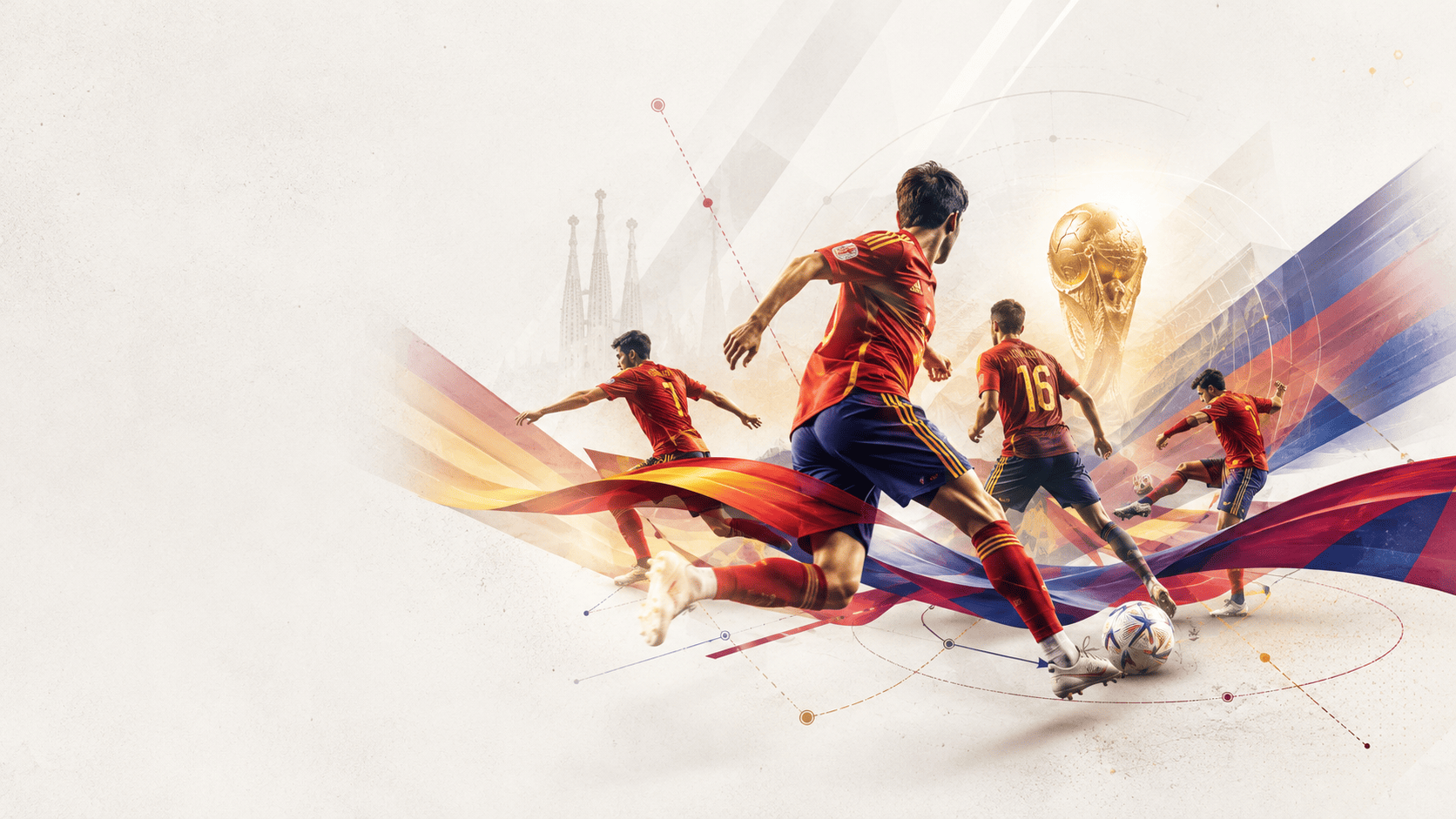
Spain defeated Argentina 1-0 after extra time on July 19, 2026, with Ferran converting Nico Williams’ headed lay-off in the 106th minute. It was Spain’s second world title, 16 years after Andrés Iniesta—another Barcelona player—scored the decisive goal in the 2010 final.
It would still be misleading to suggest that Barcelona won the tournament alone. Rodri was Spain’s midfield leader and the player of the tournament. Fabián Ruiz, Mikel Oyarzabal, Nico Williams, Mikel Merino, Marc Cucurella, Pedro Porro and Unai Simón were all essential.
Barcelona’s real contribution was more structural. The club supplied Spain with its largest single group of players, several La Masia graduates, established on-field relationships and a shared understanding of possession, pressing and positional play.
The Eight Barcelona Players in Spain’s Squad
Luis de la Fuente selected eight Barcelona players for the tournament:
- Joan García
- Eric García
- Pau Cubarsí
- Gavi
- Pedri
- Dani Olmo
- Ferran Torres
- Lamine Yamal
No other national team at the tournament had more Barcelona players. The group also matched the club’s record from Spain’s 2010 World Cup-winning squad, which contained eight Barça representatives.
The deeper connection was La Masia. Lamine, Gavi, Cubarsí, Eric and Olmo all spent important formative years in Barcelona’s academy. Pedri, Ferran and Joan developed elsewhere, but their daily work at club level placed them inside the same football environment.
Across both teams in the final, nine players had passed through La Masia. The list included Lionel Messi, Alejandro Grimaldo and Marc Cucurella as well as members of Spain’s Barcelona contingent. The final therefore reflected not only the strength of Barça’s current squad, but also the academy’s wider influence on elite football.
A Shared Football Language
International coaches have limited time. They cannot spend an entire season building automated movements and partnerships. Players arrive from different clubs, complete a small number of training sessions and are expected to perform immediately.
A large Barcelona group reduced that problem for Spain.
Cubarsí already understood the type of passing angles Pedri wanted. Pedri knew where Olmo would look for space between the lines. Lamine recognised when a midfielder or full-back was approaching to create an overload on the right.
Those connections reduced hesitation. Players did not always need to look before moving or receiving because they had already experienced similar situations at club level.
Spain did not copy Barcelona’s formation or tactics in full. De la Fuente added Rodri’s authority, Fabián’s forward movement, Nico Williams’ speed, Oyarzabal’s intelligent positioning and Merino’s physical impact. Yet the Barcelona core gave him a functioning platform rather than a collection of unfamiliar individuals.
Pau Cubarsí and the First Pass of the Attack
Cubarsí represented one of Barcelona’s most important contributions. His value was not limited to defensive duels. He gave Spain a centre-back capable of progressing the ball through pressure.
Against Argentina, Spain frequently tried to attract the front two before finding a free player behind them. Oyarzabal dropped from the forward line, Fabián moved higher and Dani Olmo searched for pockets between midfield and defence.
Cubarsí’s passing allowed Spain to find those players directly. Argentina could either remain compact and allow him time, or step forward and risk opening space behind the first line.
The final’s tactical patterns showed how Spain used Cubarsí as a line-breaking option, particularly when Olmo became available inside. His aggressive positioning also helped the team sustain attacks and recover possession before Argentina could counter.
His influence had already been visible in the quarter-final against Belgium. Cubarsí’s shot from outside the area forced a save before Mikel Merino converted the rebound for the 88th-minute winner. He was therefore involved at both ends of the pitch during one of Spain’s most difficult matches.
Lamine Yamal Changed the Shape of Opposing Defences
Possession alone does not always break a compact defensive block. Spain needed a player who could defeat an opponent individually, and Lamine Yamal provided that threat.
De la Fuente generally kept him wide on the right. His position stretched defensive lines and created a dilemma for the opposing left-back. Moving wide to confront Lamine opened an inside lane for Olmo or a midfielder. Staying narrow gave the Barcelona winger room to receive and attack one against one.
Lamine scored in Spain’s 4-0 group-stage victory over Saudi Arabia. He was later named player of the match against Belgium and won the penalty that opened the scoring against France in the semi-final.
He did not score in the final, but his positioning remained important. Nicolás Tagliafico was repeatedly pulled towards the touchline, creating opportunities for Olmo to operate inside.
That is why Lamine’s influence cannot be measured only through goals and assists. His presence altered how opponents allocated defenders before he even touched the ball.
Dani Olmo Connected Midfield and Attack
Olmo started the final as Spain’s central attacking midfielder. His task was to find space between Argentina’s defensive and midfield lines rather than remain in one fixed position.
If a centre-back stepped out to follow him, Spain could attack the space behind. If Argentina’s defenders stayed deep, Olmo could receive, turn and combine around the penalty area.
His movements were particularly effective on Spain’s right side. Lamine held the width, while Olmo moved into the inside channel. This forced Argentina to defend both the touchline and the space between full-back and centre-back.
Olmo had already delivered a direct contribution in the semi-final, combining with Pedro Porro before assisting Spain’s second goal against France. He was also involved in the move leading to Fabián Ruiz’s opener against Belgium.
His career also illustrates La Masia’s broader value. Olmo was educated at Barcelona before leaving Spain to pursue a different development route. By the time he returned, he had combined Barcelona’s positional education with the vertical, transition-based experience acquired elsewhere.
Pedri Controlled the Rhythm
Pedri did not start the final, but he entered during the second half as Spain attempted to maintain possession and increase the quality of its circulation around Argentina’s deep block.
His importance cannot be reduced to final passes. Pedri helps a team choose the correct speed. He receives with an open body shape, protects teammates from unnecessary pressure and decides whether an attack should accelerate or pause.
He started Spain’s 3-0 Round of 32 victory over Austria and later contributed from the bench in the decisive knockout matches against Belgium, France and Argentina.
Using a midfielder of Pedri’s quality as a substitute also demonstrated Spain’s depth. De la Fuente did not need to exhaust the same starting XI throughout an eight-match campaign. He could introduce a player capable of controlling possession when opponents were tired and spaces began to appear.
Ferran Torres Delivered the Decisive Moment
Ferran provided the clearest connection between Barcelona and the final result.
He replaced Oyarzabal in the 62nd minute and occupied spaces between Argentina’s defenders and midfielders. Rather than waiting permanently between the centre-backs, he remained alert to second balls arriving around the penalty area.
In the 106th minute, Pedro Porro crossed towards the far side. Nico Williams won the aerial contact and directed the ball into Ferran’s path. The Barcelona forward arrived ahead of Argentina’s midfield protection and finished with his left foot.
The move was not produced by Barcelona players alone. Porro supplied the cross and Nico created the assist. Ferran’s role was to recognise the situation and arrive in the correct space.
His winner also highlighted one of Spain’s greatest strengths: the bench. FIFA’s technical analysis had already identified the impact of De la Fuente’s substitutions before the final. Merino had scored crucial late goals in earlier knockout rounds, and Ferran repeated the pattern on the biggest stage.
The Value of Gavi, Eric García and Joan García
Not every Barcelona player occupied a leading role, but squad depth mattered across a 38-day tournament.
Gavi came off the bench against Austria and gave Spain another option for pressing, duels and energetic movement. Eric García made his first tournament appearance during extra time in the final, replacing Aymeric Laporte at a moment when Spain needed calmness and secure distribution.
Joan García provided another goalkeeping option behind Unai Simón and David Raya. De la Fuente did not need to use every squad member equally, but he possessed alternatives who understood Spain’s build-up requirements and accepted their roles within the group.
World Cups are not won by 11 players. They require substitutes who can enter without changing the team’s identity and squad members who maintain competitive training standards even when their minutes are limited.
What Spain Took From Barcelona’s Playing Model
Barcelona finished the 2025/26 La Liga season with 68.91% average possession. Hansi Flick’s side scored 102 league goals and attempted 692 shots, including 257 on target. Those numbers show the environment in which Spain’s Barça players had spent the club season: dominating the ball, facing compact blocks and repeatedly searching for small openings.
Spain produced a similar level of territorial control in the final. They had 65% possession, attempted 20 shots and allowed Argentina only two. None of Argentina’s attempts was on target. Spain also generated 2.34 expected goals compared with Argentina’s 0.38.
This does not prove that De la Fuente copied Barcelona, but several principles clearly overlapped.
Control Through Possession
Spain used the ball to move opponents and create openings, not simply to accumulate passes. They circulated patiently until a line-breaking pass or one-on-one opportunity became available.
Immediate Counter-Pressing
When possession was lost, nearby players reacted aggressively. Their objective was to stop transitions before Argentina or another opponent could attack the space behind Spain’s advanced structure.
Spain had conceded only one goal in seven matches before the final and then kept another clean sheet against Argentina. Their possession was therefore connected to an exceptional defensive record.
A High, Compact Structure
Cubarsí and the rest of the defence remained close to midfield. This compressed the pitch and made it easier to recover loose balls, although it also required excellent timing and recovery speed.
Patience Combined With Vertical Threat
Spain retained the traditional emphasis on passing and positional intelligence but added more direct attacking tools. Lamine and Nico stretched the pitch, Olmo found the inside channels, and Oyarzabal created space by dropping away from the last line.
These details are easier to appreciate when viewers can follow the entire tactical picture rather than only the ball. A stable viewing experience with clear picture quality—such as the supported device experience offered by Rowad4K, with quality up to 4K when available—helps reveal off-ball movement, pressing distances and the changing height of the defensive line.
Spain Was More Than Barcelona
Barcelona’s influence was substantial, but Spain’s victory cannot be honestly explained through one club alone.
Rodri controlled midfield and finished the tournament as its leading individual performer. Fabián Ruiz carried the ball forward and scored against Belgium. Oyarzabal’s movement connected midfield with attack, while Nico Williams created the winning goal in the final.
Merino repeatedly changed knockout matches from the bench. Cucurella and Porro supplied width and energy, while Unai Simón provided security in goal.
Most importantly, De la Fuente created a collective that did not depend on one superstar. After the final, he emphasised unity, solidarity and shared values as the foundation of the team’s success.
The most accurate conclusion is that Barcelona built Spain’s technical core, while the national team surrounded that core with outstanding players from several other clubs and development systems.
Barcelona’s Influence in 2010 and 2026
The two Spanish world titles contain obvious parallels. Both squads included eight Barcelona players, and both finals were decided by a Barça goalscorer.
The similarities end there.
The 2010 side was built around the control of Xavi, Iniesta and Sergio Busquets, supported by Carles Puyol, Gerard Piqué and Pedro. Its football prioritised long periods of possession and precise rhythm management.
The 2026 generation was more varied. Lamine supplied individual threat from the wing. Cubarsí progressed the ball from defence. Olmo attacked spaces between the lines. Pedri controlled tempo, while Ferran offered flexible movement as a forward.
Spain then combined those qualities with Nico’s speed, Rodri’s authority, Fabián’s forward runs and Merino’s physical impact.
The 2026 side did not attempt to reproduce 2010. It updated the same underlying ideas for a faster and more physically demanding era, adding vertical attacks, intense pressing and decisive substitutes.
So, Did Barcelona Make Spain World Champions?
Barcelona’s contribution can be divided into five areas:
- Representation: Eight Barcelona players gave Spain a major club-based core.
- Chemistry: Existing relationships reduced the time needed to build understanding.
- Development: La Masia educated several players in receiving, scanning and making decisions under pressure.
- Tactical familiarity: Possession, positional play and counter-pressing were already part of the group’s daily football.
- Decisive actions: Cubarsí, Lamine and Olmo influenced the knockout rounds before Ferran scored the winning goal.
The final element belonged to De la Fuente. He combined Barcelona’s contribution with the best qualities of Rodri, Fabián, Nico, Oyarzabal, Merino and the rest of Spain’s squad.
Barcelona did not win the World Cup in Spain’s name. It provided the foundation around which the champions were built.
The result was not a national team disguised as a club side. It was a genuinely Spanish team that made Barcelona its technical heart without allowing that heart to become the entire body.
Share this article