Iran, Tunisia and Uruguay Out of the 2026 World Cup: The Hard Lessons of the 48-Team Format
Iran, Tunisia and Uruguay left the 2026 World Cup in three very different ways, exposing the hard edge of the new 48-team format and the unforgiving race among third-placed teams
Iran, Tunisia and Uruguay Out of the 2026 World Cup: The Hard Lessons of the 48-Team Format
The exits of Iran, Tunisia and Uruguay from the 2026 World Cup were not just three separate group-stage failures. Together, they offered one of the clearest early lessons of the expanded tournament: a 48-team World Cup gives nations more room to survive, but it does not give anyone a safety net
The new format looks generous at first glance. With 12 groups of four teams, the top two from each group qualify automatically, and the eight best third-placed teams also move on to the Round of 32. That means 32 of the 48 teams continue beyond the group stage. In theory, it is a wider door. In practice, it has created a new layer of pressure, where every goal, every draw and every late result in another group can completely reshape a nation’s tournament.
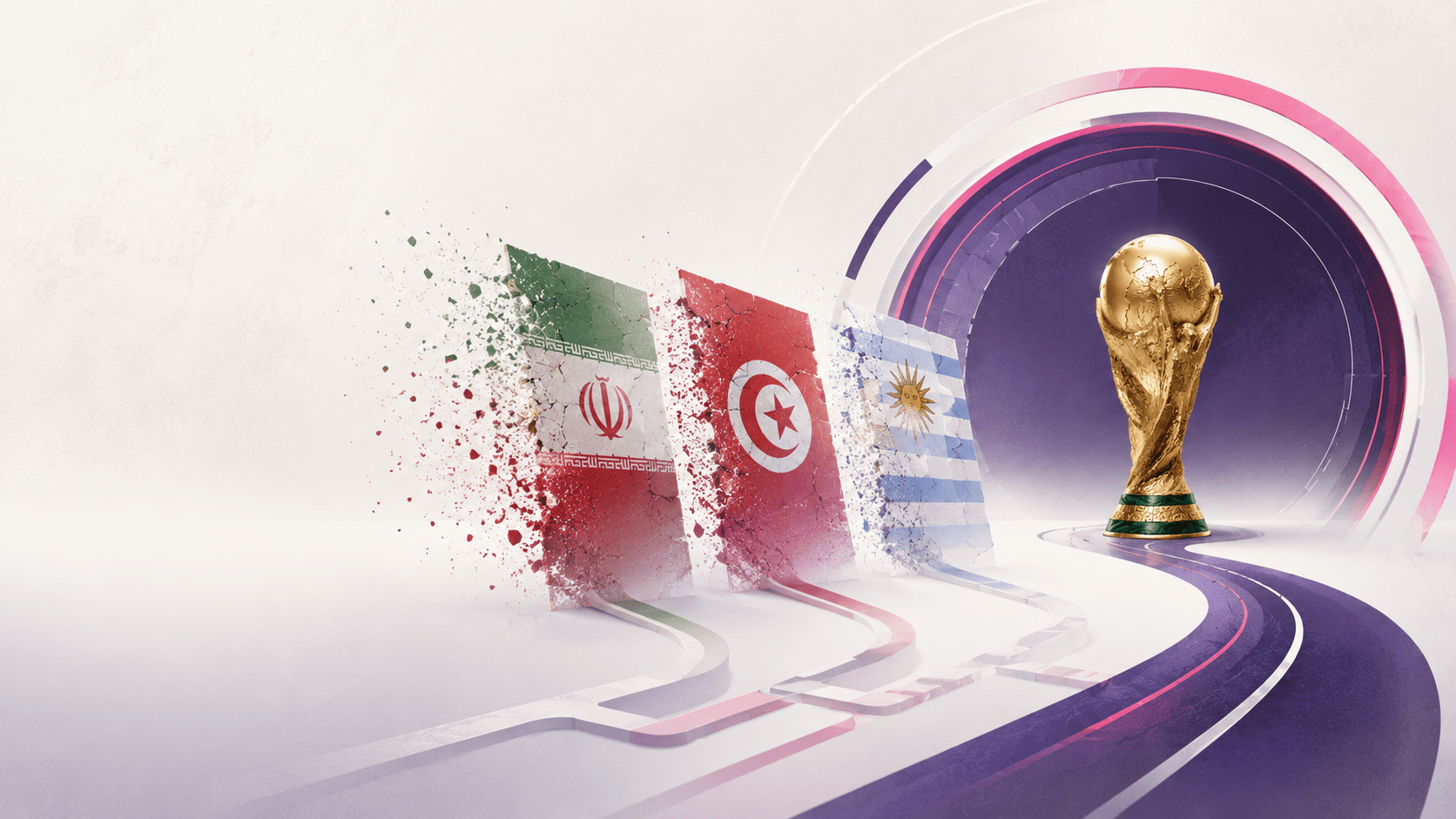
Iran, Tunisia and Uruguay all went home, but they did not go home in the same way. Iran were punished by the brutal mathematics of the third-place table despite going unbeaten. Tunisia never reached that stage of calculation, finishing bottom of their group after a painful defensive collapse. Uruguay, one of world football’s most historic names, failed to win a single match and paid the price despite the supposedly forgiving structure of the expanded competition
The 48-Team Format: More Opportunity, More Pressure
The 2026 World Cup format has changed the way the group stage is understood. In the old 32-team version, most of the attention was placed on who finished first and second. In 2026, the third-place table became a tournament within the tournament
Teams were no longer competing only against the sides in their own group. They were also competing against third-placed teams across 11 other groups. A draw in one match could feel useful for a few hours, then become meaningless after a big win elsewhere. A goal in another stadium could move a team above or below the qualification line without that team even being on the pitch
That is what made the exits of Iran and Uruguay so revealing. The format did not simply eliminate poor teams. It eliminated teams that failed to do enough in very specific ways. Iran did not lose, but they did not win. Uruguay had pedigree, but they had no victory. Tunisia, meanwhile, showed that the expanded format cannot rescue a campaign that collapses too early
Iran: Unbeaten, But Still Out
Iran’s exit was the most painful from a mathematical perspective. The team finished its group-stage campaign unbeaten, with three draws, but still missed out on the Round of 32. The Guardian reported that the race for the best third-placed teams went down to the final seconds of the 72-game group stage, with Iran eventually missing out alongside South Korea, Scotland and Uruguay.
This is the harshest side of the new format. Iran did enough to avoid defeat, but not enough to secure control over their own destiny. Three draws gave them three points, but in the best-third-place race, three points were always vulnerable
Their fate became even more agonising because it was affected by late drama elsewhere. According to The Guardian, Iran appeared to be heading through after Algeria scored late against Austria, only for Austria’s 96th-minute equaliser to change the picture and save Austria while leaving Iran outside the qualification places.
That moment captured the emotional cruelty of the expanded World Cup. Iran had finished their own work. Then they had to wait. Then their tournament was effectively ended by a goal in a different match
Was Iran unlucky? Yes. Were they robbed? Not exactly. The rules were known from the beginning. In a format where third-placed teams are ranked against one another, wins carry enormous value. Iran’s unbeaten record showed organisation and resilience, but the absence of a victory left them exposed
The lesson is simple: in the 48-team World Cup, survival is not the same as progress. You can avoid defeat and still fail to advance
Tunisia: A Campaign That Fell Apart Too Quickly
Tunisia’s exit was different. Unlike Iran, Tunisia were not eliminated by the fine margins of the third-place table. They finished bottom of Group F with zero points and a goal difference of minus 10, according to The Guardian’s final group standings.
Their tournament was painful from the start. A heavy 5-1 defeat to Sweden opened the campaign, followed by a 4-0 loss to Japan and a 3-1 defeat to the Netherlands. Al Jazeera reported that Tunisia conceded 12 goals in three matches, and that a mid-tournament coaching change could not stop the decline.
This was not a case of the format being unforgiving. It was a case of a team falling too far behind too quickly. The expanded World Cup offers more paths to the knockout stage, but those paths still require basic competitive stability. Tunisia never had that stability
For Arab fans, Tunisia’s exit was especially frustrating. The new format was expected to give teams outside the traditional elite a better chance of reaching the knockout stage. Tunisia had long carried the burden of repeated group-stage exits. In 2026, there was hope that the wider structure might finally open a new door
Instead, the campaign became a reminder that opportunity means little without balance. A team can lose to strong opponents, but conceding heavily across three matches destroys any chance of staying alive in a format where goal difference can become decisive
Uruguay: A Giant Name, No Wins
Uruguay’s elimination may be the most dramatic in terms of reputation. This is a two-time world champion, a country with deep World Cup history, and a squad packed with high-level players. Yet Uruguay left the tournament without a single win
Reuters reported that Marcelo Bielsa’s side exited after drawing with Saudi Arabia and World Cup debutants Cape Verde, then losing 1-0 to Spain. Uruguay became the only CONMEBOL team not to reach the knockout stage in a 48-team tournament that, on paper, gives established powers more room to recover from setbacks.
In Group H, Spain finished top with seven points, Cape Verde advanced in second place with three, while Uruguay finished third with only two points. Saudi Arabia also finished on two points, but Uruguay’s third-place finish still meant little because their total was far below what was needed in the cross-group ranking.
This is the sharpest criticism of Uruguay’s campaign: the format did not work against them as much as they failed to use it. In a 32-team World Cup, finishing third often meant automatic elimination. In 2026, third place could still be enough. But two points and no wins are rarely a serious argument for survival
Reuters also pointed to the quality of players Bielsa had available, including Federico Valverde, Rodrigo Bentancur, Manuel Ugarte and Darwin Núñez. Yet the team looked disconnected and struggled to turn possession and pressure into goals.
Uruguay’s exit was therefore not just a bad result. It was a failure of translation: talent did not become control, control did not become goals, and reputation did not become qualification
Three Exits, Three Different Meanings
Putting Iran, Tunisia and Uruguay together under one headline makes sense because all three became major group-stage casualties. But the details matter
Iran were a victim of the third-place race in its purest form. They stayed unbeaten but failed to win, then watched the final table move against them
Tunisia were not really a victim of the third-place system. They finished fourth, conceded heavily, and left the tournament with no points
Uruguay were caught somewhere in between. They finished third, but with such a weak points total that the safety route offered by the new format was never truly within reach
That distinction is important. The 48-team format did not punish these teams in one identical way. It exposed different weaknesses in each of them
Iran lacked the decisive win. Tunisia lacked defensive control. Uruguay lacked attacking efficiency and tournament authority
The New Drama of the Third-Place Table
The best-third-place race has become one of the defining features of the 2026 World Cup. Bolavip’s final third-place standings showed DR Congo, Sweden, Ghana, Ecuador, Bosnia and Herzegovina, Algeria, Paraguay and Senegal advancing, while Iran, South Korea, Scotland and Uruguay missed out.
For fans, this creates a gripping viewing experience. Every match matters. Every late goal matters. Even a result between two teams in another group can decide the fate of a country that has already finished playing
For teams, however, it creates a more stressful tournament. It is not enough to manage your group. You must manage your numbers. Points are the first priority, but goal difference and goals scored can quickly become just as important
That is why a stable viewing experience becomes part of the modern World Cup experience. When a 96th-minute equaliser can change Iran’s fate, or a single Spain goal can end Uruguay’s campaign, fans need to follow every decisive second clearly and reliably. A service like Rowad4K fits naturally into that context by offering football fans a smoother way to follow major matches, preferred sports channels and high-pressure tournament moments with strong picture quality and dependable access
What the Exits Say About the Expanded World Cup
The expanded World Cup is not automatically easier. It is wider, but it is also more layered. It gives more countries a chance, but it also forces teams to think about the full tournament picture from the first whistle
For mid-level teams, one win can be transformative. For bigger teams, failing to win can be fatal. For teams that concede heavily, the expanded format offers no protection at all
Iran, Tunisia and Uruguay learned this in three different ways. Iran discovered that avoiding defeat does not guarantee advancement. Tunisia discovered that a poor start can make the wider format irrelevant. Uruguay discovered that history and talent mean little without results
Conclusion: A Bigger World Cup, But Not a Softer One
The exits of Iran, Tunisia and Uruguay from the 2026 World Cup prove that expansion has not made the tournament forgiving. It has made it more complex
There are more qualification routes, but also more ways to fall short. A team can lose control of its fate through one missing win, one heavy defeat, or one goal scored in another stadium
Iran left unbeaten but eliminated. Tunisia left after a campaign that never found balance. Uruguay left as a historic name that failed to win a single match
That is the hard truth of the 48-team World Cup: the door is wider, but the pressure is sharper. The new format gives teams more hope, but it also demands more precision. In 2026, opportunity was not enough. Only teams that turned opportunity into results survived
For viewers, that means more drama, more simultaneous calculations and more decisive moments. For fans following the tournament through Rowad4K, the value lies in watching those moments with clarity, stability and easy access to the matches that matter most, because in this World Cup, one late goal can change everything
Share this article