From Interim Coach to Argentina’s Era-Defining Leader: Lionel Scaloni’s Success Story
From a widely questioned interim appointment to two consecutive World Cup finals, explore how Lionel Scaloni rebuilt Argentina, empowered Lionel Messi and created the enduring identity of La Scaloneta.
From Interim Coach to Argentina’s Era-Defining Leader: Lionel Scaloni’s Success Story
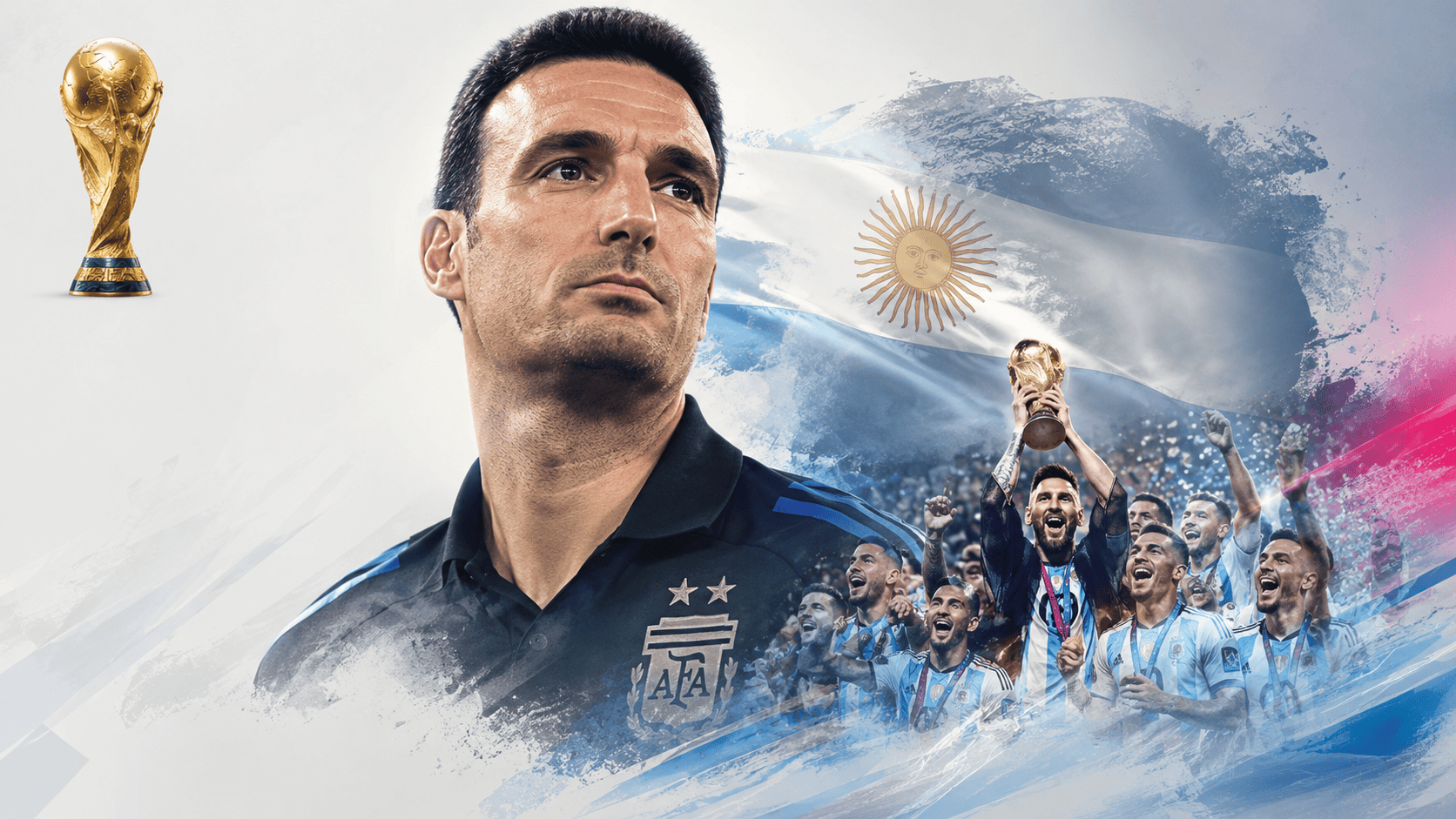
Lionel Scaloni can no longer be described simply as the coach who helped Lionel Messi win the World Cup. After guiding Argentina into the 2026 FIFA World Cup final, he has become the architect of an entire era—one built on continuity, tactical adaptability, emotional intelligence and an unusually strong collective identity.
The latest chapter unfolded in Atlanta, where Argentina appeared to be heading out of the tournament after Anthony Gordon put England ahead in the second half. Scaloni’s team refused to unravel. Enzo Fernández equalised in the 85th minute before substitute Lautaro Martínez headed home a Lionel Messi cross in stoppage time to complete a dramatic 2-1 comeback.
It was more than a semi-final victory. It captured everything Scaloni has gradually instilled in Argentina: patience when a match becomes uncomfortable, trust in the squad, courageous substitutions and an unwavering belief that the contest is never over.
Argentina will now face Spain on Sunday, 19 July 2026, at New York New Jersey Stadium. Kick-off is scheduled for 10:00 PM Saudi Arabia time. Victory would make Argentina the first country since Brazil in 1962 to retain the World Cup.
An Appointment Few Believed In
Argentina’s situation after the 2018 World Cup was unstable. The team had been eliminated by France in the round of 16, Jorge Sampaoli’s tenure ended amid intense criticism, and Messi temporarily stepped away from international football.
Scaloni was placed in charge on an interim basis in September 2018. He had never previously managed a senior club or national team as the principal head coach. His experience largely consisted of assisting Sampaoli and working around Argentina’s youth structure.
More famous candidates had either been unavailable or unwilling to accept one of international football’s most demanding jobs. Scaloni consequently looked less like the leader of a long-term project and more like a practical solution for a difficult transitional period.
The doubts were understandable. Argentina were handing a squad led by Messi to a coach without an established managerial résumé. Yet Scaloni’s lack of baggage eventually became an advantage.
He did not arrive determined to impose a rigid personal philosophy or prove that he was tactically smarter than his players. He arrived as a former international who understood dressing-room dynamics, European football and the emotional burden attached to representing Argentina.
Copa América 2019: The Foundation, Not the Finished Product
Argentina did not immediately become champions. At the 2019 Copa América, they lost to Colombia, drew with Paraguay and needed time to find rhythm. They eventually reached the semi-finals, lost to hosts Brazil and defeated Chile in the third-place match.
The tournament nevertheless became an important laboratory. Scaloni began moving away from an ageing structure and introduced players capable of running, pressing and accepting responsibility around Messi.
He also built a collaborative coaching staff rather than presenting himself as a solitary mastermind. Pablo Aimar and Walter Samuel became influential members of a technical team based on communication, shared responsibility and complementary personalities.
Argentina left Brazil without the trophy, but the emotional atmosphere had changed. Messi looked increasingly connected to the group, younger players were earning genuine roles, and the team was developing an identity beyond the reputation of its captain.
The Night at the Maracanã
The breakthrough arrived on 10 July 2021.
Argentina defeated Brazil 1-0 in the Copa América final at the Maracanã, with Ángel Di María scoring in the 21st minute. The victory ended Argentina’s 28-year wait for a senior international trophy and gave Messi his first major title with the national team.
For Scaloni, the result was proof that his project could survive the pressure of the biggest matches. Argentina did not win through effortless domination. They defended their advantage, managed Brazil’s pressure and remained emotionally stable in a hostile environment.
That night transformed “La Scaloneta” from an affectionate nickname into the label of a footballing era.
Scaloni was no longer an interim coach who had managed to remain in the position. He was the man who had ended the drought and created the platform for something even greater.
The Finalissima and the Growth of a Complete Team
In June 2022, Argentina faced European champions Italy in the Finalissima at Wembley. Scaloni’s side delivered one of its most convincing performances, winning 3-0 and claiming a second trophy.
By then, the structure around Messi was functioning with remarkable balance. The captain retained freedom in attacking areas, but the players behind him provided running power, defensive coverage and the ability to recover possession.
Messi was no longer expected to collect the ball deep, create every opportunity and finish every move. Rodrigo De Paul, the other midfielders and an increasingly confident group of forwards shared the creative and physical burden.
This was central to Scaloni’s success: he did not diminish Messi’s influence. He made that influence more sustainable.
Qatar 2022: Defeat, Adjustment and Immortality
Argentina’s 2022 World Cup campaign began with a stunning 2-1 defeat to Saudi Arabia. The result ended the national team’s record 36-match unbeaten run and immediately placed Scaloni under enormous pressure.
The coach’s response was as important as any tactical decision he made during the tournament. He refused to treat one defeat as evidence that the entire project had failed. Instead, he made measured adjustments, protected the group from panic and restored competitive control.
Argentina defeated Mexico and Poland, then eliminated Australia, the Netherlands and Croatia. In the final against France, Scaloni again showed tactical courage, selecting a structure designed specifically to expose the opponent’s weaknesses.
Argentina controlled much of the contest, lost a two-goal advantage, regained the lead in extra time and were forced into a penalty shootout. That chaotic final demonstrated that the team no longer required ideal circumstances to succeed.
When Argentina finally lifted the trophy, Scaloni completed one of the most unlikely transformations in modern international football. A coach appointed without senior managerial experience had delivered the country’s first World Cup since 1986.
Copa América 2024: Remaining Hungry After Becoming Champions
Winning the World Cup can mark the end of a cycle. For Argentina, it became the foundation for further success.
Scaloni maintained the squad’s competitive hunger during the 2024 Copa América. Argentina progressed to another final and defeated Colombia 1-0 after extra time, with Lautaro Martínez scoring the decisive goal.
The triumph gave Scaloni his fourth title: the 2021 Copa América, the 2022 Finalissima, the 2022 World Cup and the 2024 Copa América. Argentina also became only the second national team to win two consecutive continental championships with a World Cup in between, following Spain’s run from 2008 to 2012.
The winning goal was created by players introduced from the bench, highlighting another feature of Scaloni’s management. He does not merely select a starting eleven; he maintains an entire squad in which substitutes believe they can define the tournament.
Solving the Messi Question
Scaloni’s greatest achievement may be the way he has managed Messi without allowing the national team to be consumed by his presence.
Messi remains the captain, the creative reference and the player most capable of deciding a match. But Scaloni built a team around him that accepts defensive work, covers space and takes responsibility in possession.
Rather than feeling secondary to Messi, the players became emotionally invested in helping him extend his international journey. The captain inspired the group, but the group also protected and supported its captain.
This balance released Messi from the exhausting narrative that every Argentina result was exclusively his responsibility. He no longer needed to prove his commitment in every match, while defeats stopped becoming individual trials of his career.
Scaloni also resisted the temptation to compete for the spotlight. Even after winning the World Cup, he consistently allowed the players to remain the main characters. His influence appeared in the team’s organisation, substitutions and relationships rather than public self-promotion.
Adaptability Over Tactical Dogma
Scaloni is not associated with one permanent formation. He has openly suggested that managing relationships and maintaining a healthy group matter more to him than being defined by a formation such as 4-3-3.
Argentina can therefore change shape according to the opponent. Scaloni may use a three-man midfield, introduce a player between the lines, add width to support a full-back or adopt a more direct approach when the match demands it.
This adaptability should not be confused with an absence of identity. Argentina’s principles remain recognisable:
- Compact distances between units
- Aggressive support around the ball
- Midfield responsibility
- Emotional resilience
- Tactical flexibility
- Collective protection of creative players
Scaloni’s objective is not to create a tactical spectacle that attracts attention to the coach. It is to place his players in situations where their strengths can decide the match.
World Cup 2026: A More Experienced La Scaloneta
For the 2026 World Cup, Scaloni retained much of the team that won in Qatar while adding younger players such as Nico Paz, Giuliano Simeone and Valentín Barco. Seventeen members of the selected squad had also been part of the 2022 championship group.
Argentina defeated Algeria, Austria and Jordan in the group stage, but the knockout rounds presented a much more difficult journey.
They survived a turbulent 3-2 game against Cape Verde, recovered from 2-0 down to beat Egypt 3-2 and needed extra time to overcome Switzerland 3-1.
The semi-final against England repeated the pattern. Argentina were not dominant throughout the match and fell behind in the second half. Scaloni responded by increasing the attacking risk, eventually finishing with Lautaro Martínez, Messi and Julián Álvarez involved in the search for a comeback.
The substitutes delivered, Messi created both late goals and Argentina reached a second consecutive World Cup final.
After the game, Scaloni argued that his team often produces its best football when placed under extreme pressure. He praised players who continued asking for the ball rather than becoming afraid of making the mistake that could eliminate their country.
Scaloni’s Argentina Record
Scaloni reached his 100th match against Cape Verde. The subsequent games against Egypt, Switzerland and England took his total to 103.
Before the semi-final, the Argentine Football Association recorded:
- 102 matches
- 75 wins
- 18 draws
- 9 defeats
- Four major trophies
- A national-record 36-match unbeaten run
Adding the victory over England takes Scaloni’s record to 76 wins in 103 matches, with the draw and defeat totals unchanged.
The numbers are extraordinary, but they do not fully explain the cultural transformation. Argentina moved from being a team constantly questioned over its dependence on Messi to one that enters every major tournament expecting to compete for the title.
Facing His Former Tutor in the Final
The final against Spain carries a remarkable personal storyline.
Luis de la Fuente was among Scaloni’s tutors when the Argentine completed his coaching education at the Spanish federation’s academy in 2017. Scaloni had retired as a player only two years earlier and was taking his first serious steps towards management.
His connections with Spain run deeper. He played for Deportivo La Coruña, Racing Santander and Mallorca, lives in Mallorca, and has a Spanish wife and Spain-born children.
Now the former student and former tutor will meet in the biggest match of their careers. Spain arrive as European champions, while Argentina hold both the world and South American titles.
For Scaloni, the final offers a chance to achieve something no national-team coach has managed in more than six decades: winning consecutive World Cups.
A Viewing Experience for a Historic Final
A final of this magnitude is about more than the 90 minutes. Pre-match analysis, tactical details, replays and post-match reactions all contribute to understanding how the contest was won or lost.
Through Rowad4K, football supporters can conveniently access their preferred channels and enjoy a stable viewing experience with picture quality reaching 4K on compatible devices.
High-definition coverage becomes especially valuable in major tactical contests, where a subtle movement, defensive adjustment or replayed incident can reshape the viewer’s understanding of the match.
Why Scaloni’s Story Is Different
Scaloni’s rise is exceptional not simply because he won trophies, but because of where the journey began.
He inherited a fractured national team as an interim coach without a major managerial résumé. He restored Messi’s connection with the side, introduced a new generation, formed a collaborative technical staff and developed an environment that combined emotional security with competitive responsibility.
His success was not based on one formation or one revolutionary idea. It grew from a sequence of intelligent decisions:
- Repairing the relationship between Messi and the national team
- Giving younger players meaningful responsibility
- Protecting collective unity above individual status
- Adapting tactics to each opponent
- Remaining humble after major victories
- Refreshing the squad without destroying its core
- Turning adversity into part of Argentina’s identity
Scaloni may defeat Spain and claim the fifth trophy of his tenure, or Argentina may finish as runners-up. Either outcome, however, can no longer reduce this era to a single successful tournament.
The interim coach has become one of the most important managers in Argentina’s history. La Scaloneta, once created to navigate a transitional crisis, now stands one match away from entering one of the rarest chapters in World Cup history.
Share this article