Roberto Mancini Returns as Italy Coach: A New Azzurri Era Begins
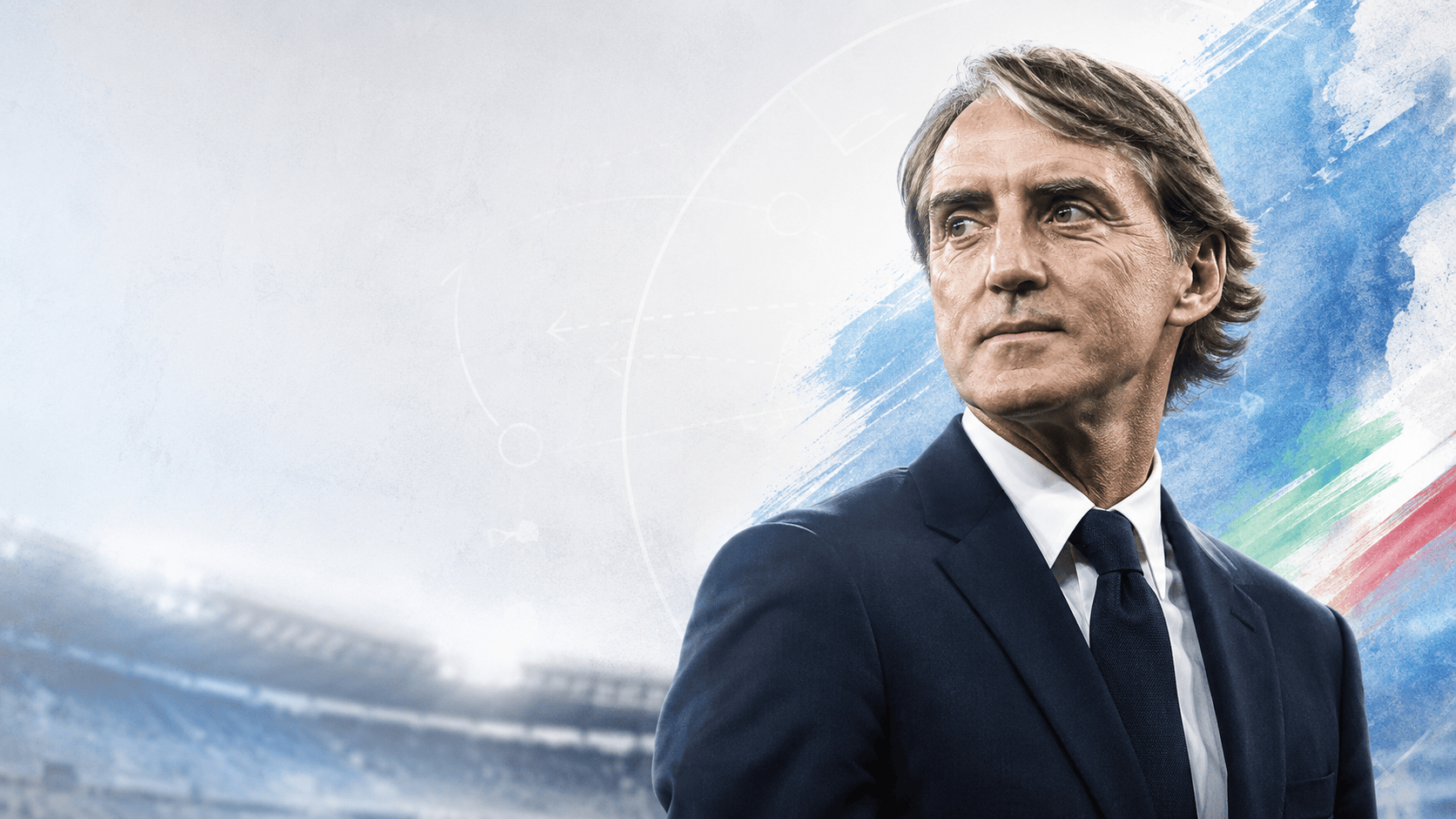
Roberto Mancini has returned as Italy head coach on a four-year contract, joining Claudio Ranieri in a major project to rebuild the Azzurri and end their World Cup absence.
Roberto Mancini Returns as Italy Coach: A New Azzurri Era Begins
Roberto Mancini is back in charge of Italy, but his second appointment is about much more than bringing a familiar face back to Coverciano. The Italian Football Federation is attempting to end a period of sporting and institutional turmoil after the Azzurri missed a third consecutive World Cup, Gennaro Gattuso left the job and the search for a successor became increasingly chaotic.
Mancini was officially reappointed on July 28, 2026, while Claudio Ranieri was named FIGC Technical Director and President of Club Italia. Their joint presentation the following day outlined a four-year project built around rebuilding public trust, creating a recognisable playing identity, giving young Italian players a genuine pathway and connecting the senior team more closely with the youth national sides.
This is Mancini’s second attempt to revive Italy after a World Cup qualification disaster. He succeeded spectacularly the first time by winning Euro 2020, yet the new assignment is arguably harder. Italy are not simply recovering from one painful elimination. They are trying to reverse a pattern that has kept the four-time world champions out of the 2018, 2022 and 2026 tournaments.
The Official Details Behind Mancini’s Italy Return
FIGC President Giovanni Malagò announced Mancini’s appointment after a Federal Council meeting, describing him as the right choice to lead the national team. Ranieri’s arrival alongside him is equally significant. The former Leicester City and Roma coach will oversee technical operations and elite development across Italy’s national-team structure, giving the federation an experienced figure above the day-to-day work of the senior coach.
Mancini returned 1,081 days after resigning in August 2023. That departure damaged his relationship with many supporters, particularly because he soon accepted the Saudi Arabia job. At his new unveiling, Mancini confronted the issue rather than avoiding it. He admitted that poor communication with former FIGC President Gabriele Gravina contributed to the split, expressed regret and said he now had an opportunity to put things right.
The four-year contract places the 2030 World Cup at the end of the project. The immediate targets are to compete strongly in the Nations League and qualify for the next European Championship, but the defining objective is clear: Italy must return to the World Cup. Mancini also spoke ambitiously about winning one or even two trophies, although his first task will be to make the team coherent, competitive and emotionally connected to its supporters again.
Why Italy Turned Back to Mancini
Mancini’s return was shaped by necessity as much as nostalgia. Gattuso’s tenure ended in April after Italy lost a World Cup play-off final to Bosnia and Herzegovina on penalties. The Azzurri had finished behind Norway in their qualifying group, entered the play-offs again, defeated Northern Ireland in the semi-final and then collapsed in the decisive match in Zenica despite taking the lead.
The federation then went through a difficult coaching search. High-profile options were explored, Andrea Pirlo’s candidacy fell apart amid controversy over his commercial links, and Paolo Maldini and Leonardo resigned from their new FIGC roles. By the time Malagò needed to stabilise the situation, Mancini offered a rare combination of international experience, knowledge of the Italian system and proof that he could rebuild the Azzurri from a low point.
That does not make him a risk-free choice. Mancini was also in charge when Italy failed to qualify for the 2022 World Cup, and the manner of his 2023 exit remains part of the discussion. His second spell is therefore a test of both technical ability and personal credibility. He must prove that the success of 2021 can inform a new cycle without trapping the team in nostalgia.
What Mancini Achieved in His First Spell
Mancini first took over in May 2018 after Italy had missed the World Cup in Russia. He gradually moved the team away from fear-driven football and built a possession-based side with a technically strong midfield, aggressive full-backs and fluid movement across the front line.
The result was Italy’s victory at Euro 2020, completed at Wembley on July 11, 2021 with a penalty-shootout win over England. His team also finished third in two Nations League campaigns and went 37 consecutive matches unbeaten. According to the federation’s official record, Mancini managed 61 Italy games and won 37, placing him third among Azzurri coaches for both appearances and victories behind Vittorio Pozzo and Enzo Bearzot.
The decline that followed is just as relevant as the triumph. Italy lost attacking efficiency, dropped costly points in World Cup qualifying and were eliminated by North Macedonia in the play-offs. The lesson for Mancini is obvious: a successful structure cannot remain static. The second project must evolve as the player pool, opponents and demands of international football change.
How Italy Could Play Under Mancini Again
Mancini said that the system must fit the players rather than the other way around, but he also made clear that he wants Italy to play attractive, proactive football. That naturally raises the prospect of a return to the 4-3-3 that defined the best phase of his first spell.
The current pool still provides a strong foundation in several areas. Gianluigi Donnarumma offers leadership and elite experience in goal. Alessandro Bastoni, Riccardo Calafiori and Giorgio Scalvini give Italy different defensive profiles, while Nicolò Barella and Sandro Tonali can form the basis of a high-level midfield. Younger players such as Marco Palestra, Niccolò Pisilli and Francesco Pio Esposito offer development potential and could help refresh the squad.
The central challenge is not simply selecting talented individuals. Mancini must create reliable mechanisms for building from the back, pressing after possession is lost, progressing through midfield and breaking down compact opponents. Italy have too often looked comfortable until reaching the final third, where possession has failed to produce enough clear chances.
A 4-3-3 may be the logical starting point, but flexibility will matter. Several leading Italian players are accustomed to back-three systems at club level, and the national coach cannot ignore those habits. Mancini’s best work previously came when the structure was clear but player movement was flexible. Recreating that balance will be more important than defending one formation as an ideological choice.
Youth Development Is Now a Core Part of the Job
Italy’s June 2026 friendlies offered an early glimpse of the next generation. Interim coach Silvio Baldini selected a squad with an average age of 20 years and six months, including four players born in 2008, three born in 2006, seven born in 2005 and nine born in 2004. The experiment gave young players senior exposure and provided the incoming coach with useful information before his first competitive window.
Mancini has a record of promoting young talent and insisted at his presentation that Italy still possesses enough quality. His concern is opportunity: young Italians must play regularly at club level if they are expected to develop into reliable internationals. He also argued that the Under-18, Under-19, Under-20 and Under-21 teams should share a consistent football philosophy.
That idea could become the most important part of the project. Italy’s problem cannot be solved by changing the senior coach every time qualification goes wrong. A sustainable recovery requires a clearer pathway from youth football to Serie A and then to the national team. Ranieri’s technical-director role gives the federation a chance to make that pathway institutional rather than dependent on one coach’s preferences.
The objective should not be to select the youngest possible squad for publicity. Italy need to identify players who are ready for senior football, introduce them within a stable structure and give them meaningful competitive minutes. Symbolic call-ups followed by months of exclusion will not produce the next generation.
Claudio Ranieri’s Role in the Rebuild
Ranieri adds experience, authority and calm to a federation recently marked by resignations and disagreement. His remit extends beyond advising Mancini. He will help coordinate the wider technical structure, oversee elite development and support a more unified direction across Italy’s national teams.
Malagò said he consulted Ranieri about Mancini before completing the appointment and received an immediate endorsement. That alignment is a useful starting point. It should reduce the risk of the senior coach working in isolation and create a clearer division between short-term selection decisions and long-term player development.
The partnership will still be judged by results. Institutional language means little unless Italy identify players earlier, give them a consistent tactical education and manage the transition into senior international football more effectively.
Ranieri could also become an important link between the federation, the coaching staff and Serie A clubs. One of the central problems facing any Italy coach is the limited time available with players and the competing interests of the domestic calendar. A respected technical director may not eliminate those tensions, but he can give the national-team project a stronger voice.
A Demanding Nations League Schedule Awaits
Mancini will not ease into the job with a run of low-pressure friendlies. His first competitive match is against Belgium in Rome on September 25, 2026. Italy then travel to Türkiye on September 28 and France on October 2, host Türkiye on October 5 and France on November 12, and finish away to Belgium on November 15.
The group provides an immediate benchmark. France will test Italy’s ability to defend space against elite speed and individual quality. Belgium will challenge their organisation and control, while Türkiye can punish mistakes in transition and force the Azzurri to solve a disciplined defensive structure.
Results will matter, but the early performances should also reveal whether Mancini’s ideas are taking hold. Italy need recognisable patterns in possession, coordinated pressing, greater variety around the penalty area and the mental strength to manage difficult phases without losing their shape.
For Arabic-speaking football fans, the Nations League campaign will offer a close look at the rebuild from its first competitive night. A stable viewing experience helps supporters follow tactical details as well as decisive moments, and Rowad4K provides access to preferred sports content across multiple devices, with picture quality up to 4K and an easy way to move between channels and matches.
The Biggest Challenges Facing Mancini
Winning Back the Supporters
Mancini’s apology was necessary, but forgiveness will depend on what happens next. Supporters will look for commitment, clarity and consistency. Strong results would accelerate the process, yet a healthier relationship will also require better communication than the one that preceded his departure in 2023.
Mancini said he wanted to produce a team attractive enough to make supporters fall in love with the Azzurri again. The sentiment is understandable, but reconciliation will be achieved through sustained work rather than one emotional press conference.
Solving Italy’s Attacking Problem
Italy continue to produce defenders and midfielders capable of competing at a high level, but the national team has lacked consistent scoring solutions. Mancini needs more than one reliable centre-forward option. He must improve the movement and supply around the striker, generate goals from wide areas and increase the attacking contribution of midfielders.
Francesco Pio Esposito and other emerging forwards may become part of the solution, but placing the entire burden on one young player would be misguided. Italy’s attacking recovery must be collective, involving faster circulation, better occupation of the penalty area and more runners arriving from midfield.
Balancing Experience and Renewal
Removing experienced players too quickly could leave the team without leadership. Depending on them for too long would delay the rebuild. Mancini must connect the established core — including Donnarumma, Barella, Tonali and Bastoni — with younger players who receive meaningful minutes rather than symbolic call-ups.
He must also judge players by their suitability for the national team, not only their status at club level. An established name may need a different role in international football, while a less celebrated player could become valuable because of his tactical fit.
Ending the World Cup Absence
Everything ultimately leads to 2030. Missing three consecutive World Cups has transformed qualification from an expectation into the central measure of Italian football’s recovery. Nations League progress and Euro qualification will matter, but Mancini’s four-year contract will be judged most severely on whether the Azzurri finally return to the global stage.
Italy have not played a World Cup knockout match since winning the trophy in 2006. They exited at the group stage in 2010 and 2014 before missing the next three editions entirely. That timeline explains the pressure surrounding Mancini’s return and why qualification can no longer be treated as a routine step.
Can Mancini Recreate the Spirit of 2021?
He should not try to recreate the exact team of 2021. The players are different, the context is harsher and the damage to confidence is deeper. What he can recover is the process that made that side successful: technical courage, a clear collective identity, competition for places and a willingness to trust players before they became obvious choices.
Mancini knows the federation, the pressure and the emotional weight of the shirt. Ranieri’s presence could provide structural support that was missing during the final months of his first tenure. Yet familiarity can also become a weakness if it prevents honest evaluation or encourages the return of players based on old relationships rather than current performance.
Early victories would help, but the project should be evaluated through more than scorelines. Italy need to show that their player pool is expanding, their football is becoming more coherent and the same weaknesses are not simply returning whenever the pressure rises.
A New Beginning, Not a Trip Back in Time
Roberto Mancini’s official return gives Italy a recognisable leader at a moment of uncertainty, but the appointment will only succeed if it looks forward. Wembley is part of the evidence that he can rebuild the Azzurri; it cannot be the blueprint copied without adjustment.
The first signs of the new plan are coherent: a four-year contract, collaboration with Ranieri, an emphasis on youth and a commitment to proactive football. The real evaluation begins against Belgium in September, when the project moves from press-conference promises to competitive action.
If Mancini restores trust, builds a deeper player pool and takes Italy back to the major tournaments, his return could become the starting point of a genuine revival. If the federation treats him merely as a comforting link to its last great night, the same structural problems will remain.
Italy’s new era will be defined not by who has returned, but by what the Azzurri are finally willing to change.
Share this article