The Secret of Number 11 in Football: Tactical Necessity or a Relic of the Past?
A deep dive into the "Magic Number" of football. From British school courtyards and cricket traditions to the modern tactical balance required for the 2026 World Cup.
The Secret of Number 11 in Football: Tactical Necessity or a Relic of the Past?
When we sit before our screens to witness the magic of the pitch—especially with the 2026 World Cup fast approaching—we often lose ourselves in the nuances of formations, substitutions, and individual brilliance. But have you ever paused to ask a question that seems simple yet carries centuries of history: Why is a football team composed of 11 players? Why not 10 to create more space, or 12 to bolster defensive density? Was this number born from a complex tactical study of the green turf, or is it merely a historical accident inherited from old British sports? In this comprehensive analysis, we decode the "Number 11 Code," diving into the historical, geometrical, and tactical dimensions that made this number the gold standard for the world's most popular game.
Before we embark on this journey through time and strategy, it is vital to recognize that appreciating the intricate movements of these 11 players requires an exceptional viewing experience. This is where the importance of cutting-edge broadcasting technology comes in. Services like Rowad 4K ensure that Arab fans can follow every pass and tactical shift with ultimate clarity and stability. By eliminating the lag and interruptions that ruin the immersion into footballing genius, Rowad 4K puts you at the heart of the stadium, as if you were the manager directing the eleven chess pieces on the board.
Historical Roots: Cricket and English School Rules
To find the origin of the number 11, we must travel back to 19th-century England, the cradle of modern football. During that era, football was not played with unified rules; every school and university had its own local version. Some schools played with 15 players, others with 20, and some matches even saw 50 students per side, where the game relied more on brute force and momentum than tactics and space.
The radical shift began with the most popular and organized sport in England at the time: Cricket. Cricket teams had officially consisted of 11 players since the 18th century. When winter arrived and cricket matches stopped due to poor weather, members of these clubs looked for another sport to maintain their fitness. They turned to football, and since their teams were already organized into 11-man squads, they naturally brought that number to the grass pitches. It was a matter of convenience and social organization rather than a scientific sporting study; they already had 11 jerseys and 11 players ready to form a side.
Another historical theory involves the dormitories of major English public schools like Eton and Harrow. Dormitories typically housed 10 students plus a "monitor" or captain. When inter-dormitory matches were organized, it was natural for the entire room to participate, resulting in 11 vs. 11. When the Football Association (FA) was founded in 1863 to draft unified laws, the number 11 was officially adopted as a compromise that satisfied both clubs and schools, marking the starting point for the game we know today.
Sports Geometry: Why is 11 the Perfect Number?
History may have imposed the number 11, but "spatial geometry" and sports physics are why it has endured for 160 years. When looking at the dimensions of a regulation football pitch (90–120 meters long and 45–90 meters wide), 11 players prove to be the magic number that strikes a perfect balance between empty space and human density.
In modern tactical science—which we will see in elaborate detail during the 2026 World Cup—the game is measured by "Space Control." If we divide the pitch area by the number of players, each outfield player is responsible for covering roughly 500 to 600 square meters. This figure represents the physical limit of what a professional athlete can cover efficiently for 90 minutes without collapsing, while simultaneously allowing enough space for passing, dribbling, and creativity.
Tactical Evolution: From All-Out Attack to Modern Balance
In the early days, the number 11 wasn't managed tactically as it is today. In the late 19th century, formations looked chaotic by today's standards—such as the (1-1-8), consisting of a keeper, one defender, one midfielder, and eight forwards! The only concept was chasing the ball toward the opponent's goal.
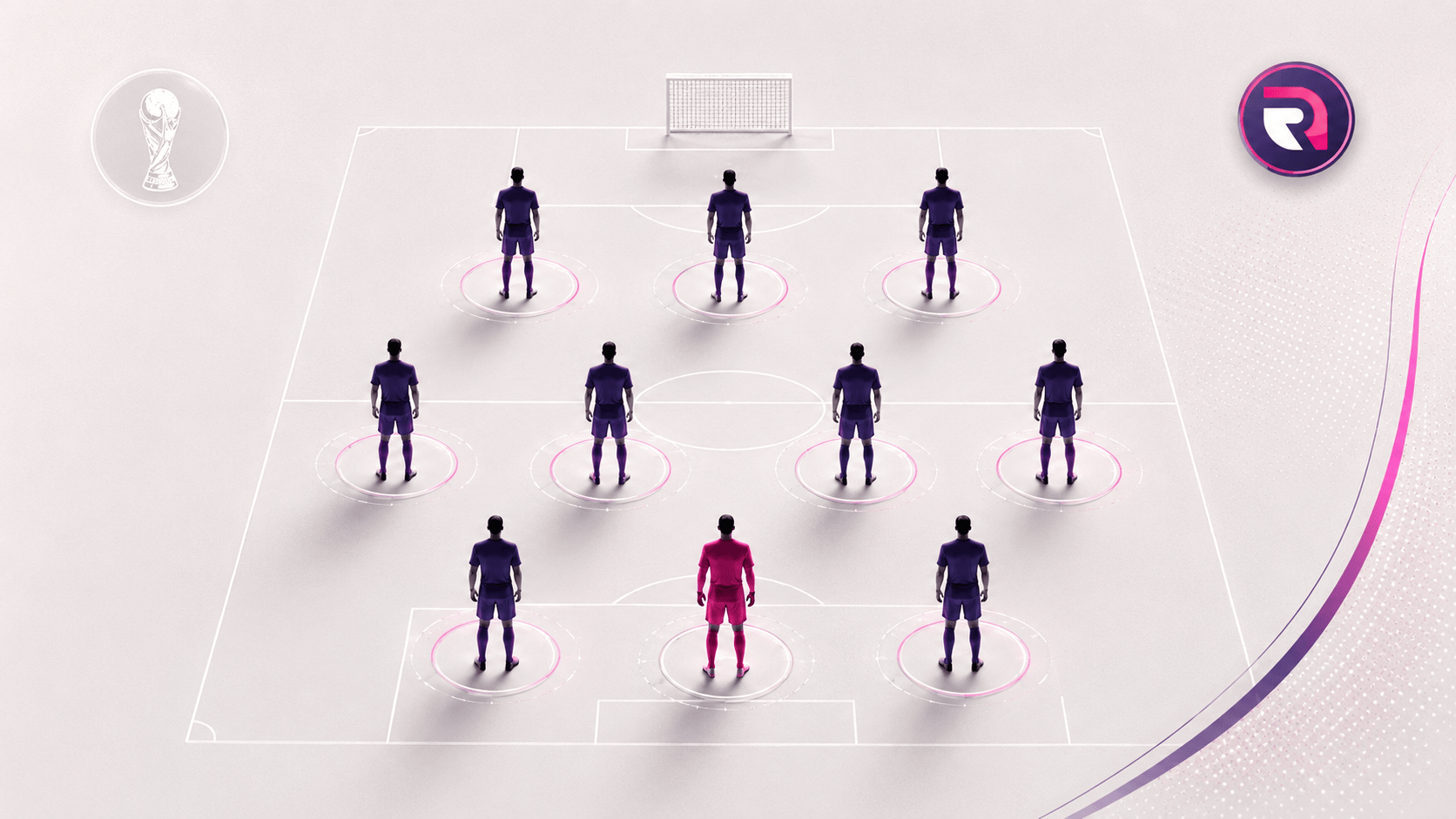
Over time, managers realized the value of using 11 players to create "lines" and "geometric triangles." The "Pyramid" (2-3-5) appeared, followed by legendary manager Herbert Chapman’s "WM" revolution (3-2-2-3). Eventually, modern formations like (4-4-2) and (4-3-3) emerged, dividing the 11 players to cover both width and depth proportionately.
The number 11 allows coaches to create "numerical superiority" (overload) in specific areas without completely abandoning others. For example, having 3 midfielders against an opponent's 2 creates a surplus that facilitates play-building. This fluid dynamic is a direct result of having 10 outfield players plus a goalkeeper. It is a precise mathematical equation that allows for the tactical genius seen in managers like Pep Guardiola and Carlo Ancelotti.
What if the Number Changed? The 10 and 12-Player Experiment
Suppose we changed the laws of the game. What if we played with only 10 players? It might sound exciting—more space means more goals and clearer individual skills. However, physiologists and tacticians argue this would be counterproductive. Vast spaces would force players to run significantly longer distances, leading to rapid fatigue, a drop in quality during the second half, and a terrifying spike in muscle injuries. Defenses would become so fragile that managers might resort to "parking the bus" just to shrink the space, killing the game's beauty.
On the other hand, playing with 12 players would cause "tactical suffocation." Passing lanes would disappear, and talented players would lose the ability to dribble or find gaps. The game would devolve into a physical struggle in a congested midfield, where the only solution would be aimless long balls, destroying the aesthetic of positional play.
The Era of Technology in 2026: 11 Under the Microscope
In 2026, football has reached unprecedented levels of physical performance and data analytics. While the number 11 remains constant, the way these players are utilized has changed fundamentally. With the five-substitution rule now a global standard, we no longer talk about just the starting 11, but the "team system." These substitutions allow for high-intensity pressing for the full 90 minutes, making the game faster and more mentally demanding.
In tournaments like the UEFA Champions League and the upcoming World Cup, we see players constantly rotating positions—a full-back tucking into midfield, or a "false nine" dropping deep to defend. This tactical fluidity requires immense spatial awareness from all 11 players. They operate as a single mind connected by a complex neural network. Any red card (reducing the number to 10) immediately disrupts this network and exhausts the remaining team, proving once again that 11 is the cornerstone of any strategy.
Conclusion: The Symphony of Eleven and the Ultimate Viewing Experience
Ultimately, the number 11 in football was not a happy accident; it was a "genius coincidence" that aligned perfectly with the pitch's geometry, human physiology, and tactical depth. It is the number that allows for the balance between blistering attack and stoic defense, between individual flair and collective discipline.
To truly appreciate this tactical harmony and understand the role of every player on the pitch, you need a viewing experience that matches this sporting artistry. As we approach the world's biggest stages, led by the talent-rich 2026 World Cup, Rowad 4K is your professional gateway to the beautiful game. It guarantees the image purity needed to see every line-breaking pass and the stability to ensure you never miss a defining moment. Enjoy the symphony of 11 players in the highest possible quality and stay at the heart of the action.
Share this article