Why Do Some World Cup 2026 Stadiums Look Bigger on TV?
Some World Cup 2026 stadiums look much bigger on TV than others, but the reason is not always the pitch size. Camera angles, stadium architecture, lighting, grass, and broadcast quality shape what viewers actually see
Why Do Some World Cup 2026 Stadiums Look Bigger on TV?
During the 2026 FIFA World Cup, fans are not only talking about goals, tactics, refereeing decisions, and surprise results. Another question keeps appearing among viewers: why do some World Cup stadiums look much bigger on television than others? One match may feel wide, spacious, and almost cinematic, with players looking smaller and passing lanes appearing huge. Another match, played on a similarly regulated football pitch, may feel tighter, faster, and more crowded.
The answer is more interesting than simply saying “one stadium is bigger.” In most cases, what viewers notice is not a dramatic difference in the field of play itself, but a combination of camera position, stadium architecture, pitch surroundings, lighting, grass appearance, and broadcast quality.
The 2026 World Cup makes this especially noticeable because the tournament is spread across Canada, Mexico, and the United States, using 16 stadiums with very different designs and sporting backgrounds. Some are traditional football venues, some are massive NFL-style stadiums, and others are modern multi-purpose arenas built for different types of events. That variety gives every venue its own visual identity.
Are World Cup pitches actually different in size?
Football pitches are not identical in every stadium, but they are governed by clear limits. For international matches, the Laws of the Game allow the touchline to be between 100 and 110 metres, and the goal line to be between 64 and 75 metres. FIFA’s stadium guidance recommends a field of play measuring 105 by 68 metres, which is the familiar benchmark for major football venues.
So yes, there can be some variation. But that variation alone usually does not explain why one stadium looks enormous on TV while another feels compact. The stronger reason is how the pitch is framed.
A stadium may look bigger because:
- the main camera is higher
- the camera is farther from the touchline
- the lens shows more of the field
- the stands are set back from the playing area
- the roof creates a larger visual space
- the grass pattern makes distances easier to read
- the lighting opens up the picture
- the broadcast feed preserves fine details
In other words, the real pitch is one thing. The televised pitch is another.
The main camera changes everything
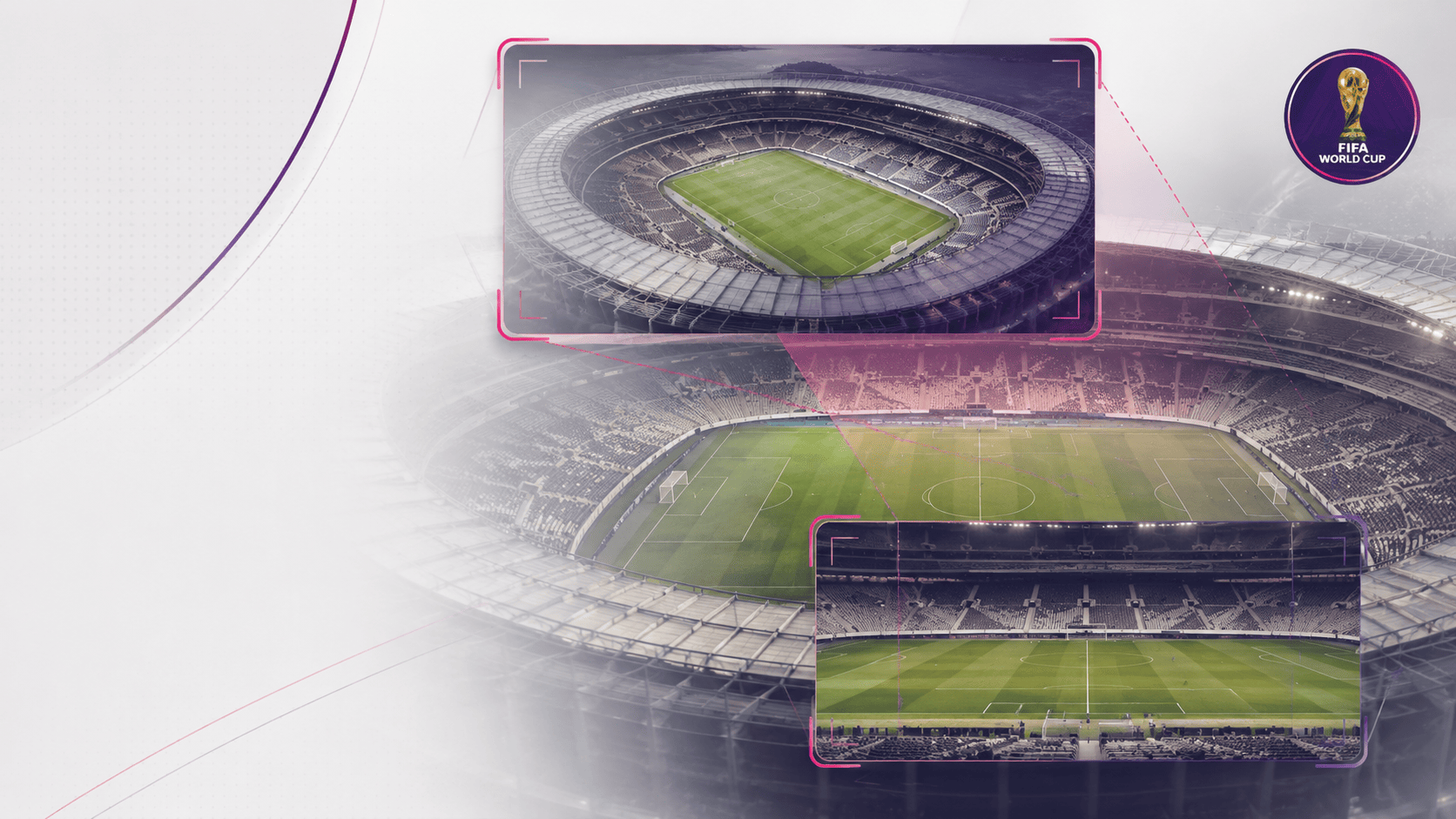
The biggest factor is the main broadcast camera. In football coverage, the main camera is usually placed around the halfway line, in the main stand, high enough to show team shapes and movement. FIFA’s stadium guidelines say camera positions should give broadcasters an optimal filming position while being integrated into spectator areas, and the main camera platform should be located on the halfway line in the main stand.
But not every main stand is built the same way. In one stadium, the camera may be very high and far from the touchline. In another, it may sit lower and closer to the pitch. That difference completely changes how the viewer reads space.
A higher, more distant camera makes players look smaller and opens up the tactical picture. You can see the defensive line, midfield spacing, switches of play, and the distance between units. A lower camera brings you closer to the action, but it can make the pitch feel tighter because the frame is filled with players rather than empty grass.
This is why the same sport can feel different from one venue to another, even when the laws and dimensions are similar.
Height affects how we read tactics
A high camera often makes a stadium look bigger because it reveals more of the field at once. It gives the viewer a tactical map. You can see how a team presses, how wide the wingers stay, and how the full-backs move into space. That makes the game feel more expansive.
A lower camera, on the other hand, makes football feel more physical. You see speed, contact, pressure, and emotion more directly. But because the picture is closer, the field can feel smaller.
Modern sports analysis treats broadcast footage as a geometric problem. Camera calibration studies in football rely on camera pose, focal length, and pitch markings to reconstruct the relationship between the 2D image on screen and the real 3D field. That tells us something important: the broadcast image is not a neutral window. It is a perspective shaped by technical choices.
Stadium design creates a visual personality
The stadium bowl also matters. If the stands are close to the pitch, the match feels intense and compact. The crowd fills the background, the advertising boards sit close to the action, and the frame feels full.
If the stadium has wider run-off areas, deeper gaps behind the goals, or stands positioned farther from the field, the whole scene looks larger. The pitch may not be dramatically bigger, but the visual stage around it is.
FIFA’s pitch guidance does not only discuss the field of play. It also refers to the grassed area beyond the lines, the placement of advertising boards, safety space, photographers, and other operational needs around the pitch. In larger stadiums, those surrounding areas can become more visible on television and make the stadium feel more spacious.
That is why a stadium built primarily for football can feel very different from a stadium designed for American football or multi-purpose events. The distance between the pitch and the spectator bowl changes the emotional feel of the broadcast.
Why 2026 makes the contrast more obvious
The 2026 World Cup is visually unique because it moves between very different venues across three countries. A match in Mexico City does not look like a match in Dallas, Los Angeles, Vancouver, Toronto, New York/New Jersey, or Kansas City. Each stadium has a different roofline, seating bowl, lighting system, camera platform, and relationship between the pitch and the stands.
This creates a constant visual contrast for fans. On the same day, viewers may move from a historic football venue to a giant American stadium and then to a more compact Canadian setting. The football may follow the same laws, but the picture does not feel the same.
That is the real reason this question has become more noticeable during the 2026 tournament: fans are comparing venues more frequently because the competition is bigger, longer, and more geographically spread out.
Lenses can stretch or compress the game
Camera lenses also influence perception. A wider lens shows more of the field and can make the space feel larger. A tighter lens compresses distance, bringing players visually closer together and making the game feel more crowded.
Football broadcasts use far more than one camera. There is the main tactical camera, pitchside cameras, goal cameras, handheld cameras, reverse angles, and sometimes overhead or suspended camera systems in larger stadiums. FIFA’s guidance notes that larger stadiums may need specialised systems such as spider-cams or boom cameras depending on broadcaster needs.
This is why the same stadium can look huge in one shot and tight in another. The wide tactical angle opens the space. A pitchside shot turns the same match into a fast, physical scene.
Grass, colour, and pitch texture matter
The surface itself also affects perception. In 2026, pitch preparation has been a major theme because several venues in North America had to use natural or hybrid grass systems for the tournament. Reuters reported that the pitches vary because the stadiums sit in very different environments, from high-altitude Mexico City to sea-level New Jersey, and from dry conditions to humid climates. FIFA also said that variations in the appearance of some surfaces on TV or in person do not necessarily reflect quality, safety, or playability.
That matters visually. Bright, evenly cut grass with clear mowing patterns can make a pitch look wider because the eye has reference lines. Darker patches, shadows, or uneven colour can make the field feel less open. White markings, the centre circle, penalty areas, and mowing stripes all help the viewer understand scale.
High-quality broadcasts make these details easier to see. Low-quality feeds flatten the picture and remove some of the visual cues that help viewers judge space.
Roofs and lighting change the sense of scale
A stadium roof can make a venue feel enormous or enclosed. A high roof creates a sense of volume. A darker or lower roof can make the picture feel tighter. Open-air stadiums also change visually depending on sunlight, shadows, and time of day.
Lighting is just as important. A stadium with even lighting looks clearer and more spacious. A stadium with strong sun-shadow contrast can visually split the pitch into zones, making it harder for the eye to read the full field as one open surface.
That is why the same venue may feel different in an afternoon match, an evening match, and a night match under full floodlights.
Does a bigger-looking stadium mean a better match?
Not necessarily. A stadium that looks large on TV may help tactical viewers understand formations and spacing. But a tighter camera can make the game feel more emotional and intense.
It depends on what the viewer enjoys:
- Tactical viewers often prefer a higher, wider angle
- Casual viewers may enjoy closer shots with more emotion
- Big-screen viewers notice stadium differences more clearly
- High-quality streams reveal pitch texture, depth, and lighting better
This is where the viewing setup matters. A stable, sharp picture does not only make the match look nicer; it helps the viewer understand the match better.
For fans following the World Cup through services such as Rowad4K, image clarity and stability are part of the football experience. A clean feed makes it easier to notice the camera angle, grass texture, crowd distance, stadium depth, and the overall visual identity of each venue. That is not a separate luxury; in a tournament like 2026, it is part of how the game is experienced.
How to spot the reason during a match
The next time a stadium looks unusually big on TV, look for these clues:
- Is the main camera very high?
- Are the players small in the wide shot?
- Is there a large gap between the pitch and the stands?
- Are the stands steep or far back?
- Is the grass pattern clear and bright?
- Is the roof creating a huge indoor volume?
- Are shadows making part of the field feel separate?
If the answer is yes to several of these, the stadium will probably feel bigger on screen, even if the pitch itself is close to standard dimensions.
The final answer
Some World Cup stadiums look bigger on TV because television does not simply show the pitch; it interprets it. Camera height, camera distance, lens choice, stadium architecture, pitch surroundings, grass, lighting, and broadcast quality all combine to shape what the viewer sees.
The 2026 World Cup makes this more obvious than usual because its venues are so diverse. Every stadium has its own visual character. Some feel like giant sporting theatres. Some feel compact and intense. Some are perfect for tactical viewing. Others pull the viewer closer to the emotion of the match.
So when a stadium looks larger on television, the screen is not necessarily lying. It is showing one version of the truth — the version created by architecture, broadcast technology, and the way our eyes read space.
Share this article