World Cup 2026 Best XI Based on Player Ratings: Messi and Mbappe Lead a Star-Studded Attack
A data-driven look at the best XI of the 2026 World Cup, explaining why Lionel Messi topped the ratings and which stars narrowly missed the final lineup.
World Cup 2026 Best XI Based on Player Ratings: Messi and Mbappe Lead a Star-Studded Attack
The best XI of the 2026 World Cup based on player ratings is not identical to FIFA’s official award list or the lineup most supporters would select from memory.
Tournament awards often reflect team success, decisive knockout performances and the wider story of the competition. Statistical ratings answer a slightly different question: which players produced the strongest and most consistent collection of measurable actions across their appearances?
Spain won the tournament by defeating Argentina 1–0 after extra time in the July 19 final, with Ferran Torres scoring the decisive goal in the 106th minute. Rodri received the Golden Ball, Kylian Mbappe won the Golden Boot with ten goals, Unai Simon collected the Golden Glove and Pau Cubarsi was named the tournament’s best young player.
Those awards provide the official verdict. The ratings, however, produce a more attack-heavy team and even leave the Golden Glove winner out of the starting XI.
How the World Cup 2026 Best XI Was Selected
The lineup is primarily based on the Team of the Tournament and average marks published by Sofascore, with FotMob’s overall rankings and post-tournament analytical selections used as supporting references.
Sofascore’s system processes hundreds of data points rather than focusing exclusively on goals and assists. Its updated model evaluates shooting, passing, dribbling and carries, defending and goalkeeping, while also considering the context and impact of each action. A progressive pass through pressure carries more weight than a safe pass that does not improve the attacking situation.
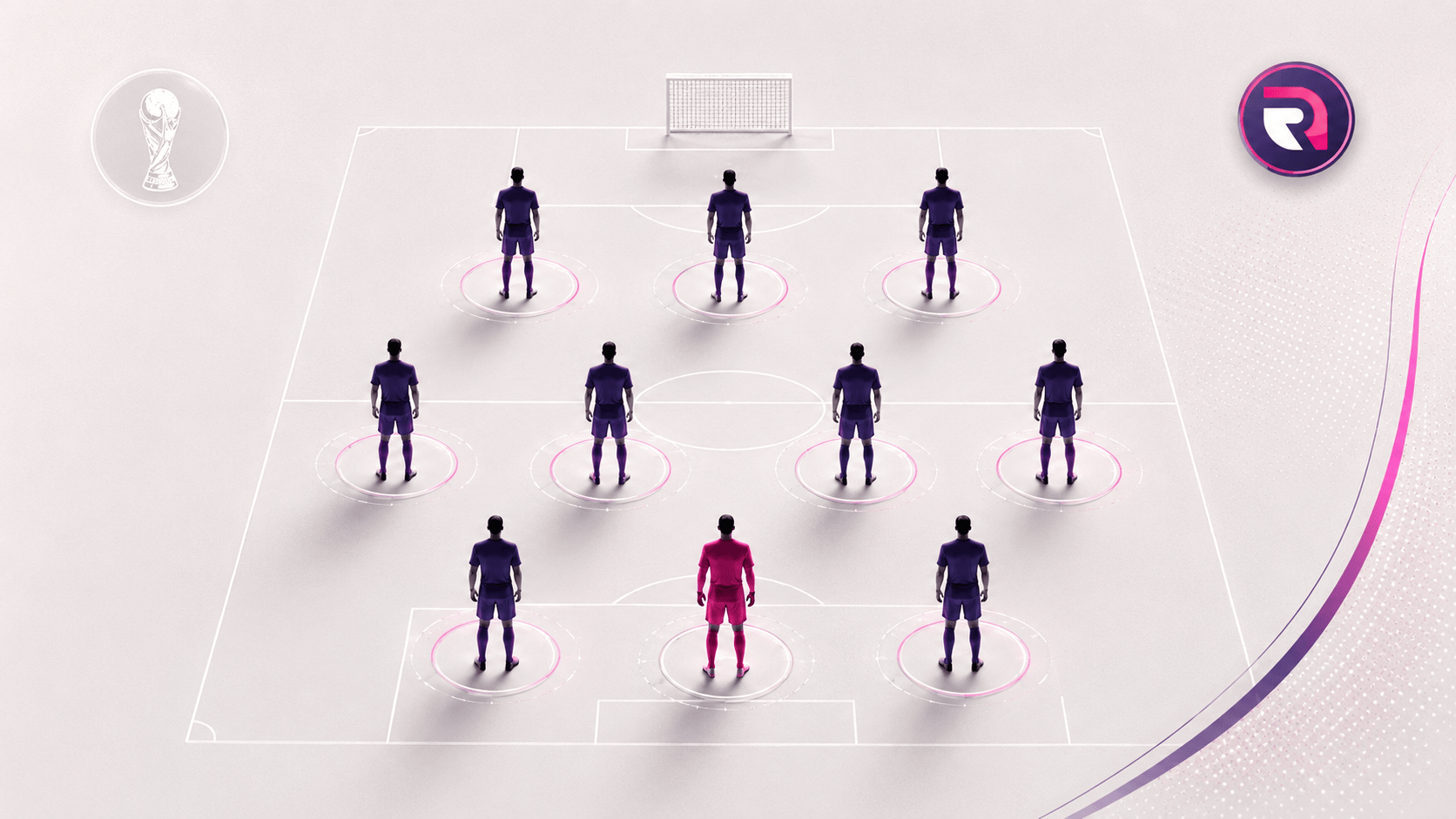
The published group of players can be arranged in a flexible 4-2-1-3 formation, with Lionel Messi operating behind the front three. In possession, it would frequently resemble an aggressive 4-2-4.
World Cup 2026 Best XI by Average Rating
Goalkeeper
- Gregor Kobel, Switzerland: 7.52
Defenders
- Pedro Porro, Spain: 7.45
- Pau Cubarsi, Spain: 7.56
- Aymeric Laporte, Spain: 7.40
- Marc Cucurella, Spain: 7.09
Midfielders
- Rodri, Spain: 7.76
- Jude Bellingham, England: 7.81
- Lionel Messi, Argentina: 8.79
Forwards
- Ousmane Dembele, France: 7.91
- Erling Haaland, Norway: 7.90
- Kylian Mbappe, France: 8.24
Messi recorded the highest Sofascore rating in the XI at 8.79. Mbappe was the next leading performer at 8.24, while five members of Spain’s title-winning team were selected.
Goalkeeper: Gregor Kobel
Gregor Kobel’s inclusion ahead of Golden Glove winner Unai Simon is the most debatable decision in the lineup.
The choice highlights one of the limitations of statistical goalkeeper ratings. A keeper playing behind a dominant defence may face very few shots, crosses or one-on-one situations. Another goalkeeper can concede more goals yet earn a higher average by recording a greater number of difficult saves and positive interventions.
Kobel averaged 7.52 as Switzerland won its group with seven points. His positioning, handling and calm distribution helped the Swiss control difficult phases without producing unnecessary rebounds or turnovers.
That does not automatically mean he had a better tournament than Simon. FIFA’s award recognised the Spanish goalkeeper’s contribution to the champion’s complete campaign, while the rating model rewarded the volume and quality of individually recorded actions.
Paraguay’s Orlando Gill was another strong candidate. He made a tournament-leading 23 saves and prevented 2.6 goals above expectation, while also becoming a national hero during the penalty shootout victory over Germany.
Right Back: Pedro Porro
Pedro Porro’s 7.45 rating reflects his influence at both ends of the pitch.
He was not Spain’s first-choice right back at the beginning of the tournament, but his introduction gave the team more natural width and a stronger attacking connection with Lamine Yamal. Porro later scored twice in the knockout rounds and was named Player of the Match in Spain’s 2–0 semifinal victory over France.
He appeared six times, scored two goals and helped Spain record five clean sheets during his appearances.
Porro was particularly effective when moving beyond the winger or stepping into the inside-right channel. His willingness to press immediately after possession was lost also suited Spain’s attempt to keep opponents trapped in their own half.
Centre Back: Pau Cubarsi
Pau Cubarsi received the highest rating among the selected defenders at 7.56, supporting FIFA’s decision to name him the best young player of the tournament.
His performance was built on more than last-ditch defending. Cubarsi regularly stepped forward to intercept passes, carried the ball beyond the first line of pressure and found midfielders through compact defensive blocks.
Spain’s possession reduced the number of traditional defensive emergencies he faced, but it increased the importance of his positioning. With the defensive line often stationed near the halfway line, one incorrect decision could have left a large space for opponents to exploit.
Cubarsi combined aggression with composure and looked comfortable performing a role normally assigned to a far more experienced centre back.
Centre Back: Aymeric Laporte
Aymeric Laporte’s 7.40 rating does not fully capture the calming influence he provided alongside Cubarsi.
Laporte played in all eight matches, completed 728 minutes, scored once and was involved in seven clean sheets. His experience gave Spain the security required to defend with an advanced line and commit both fullbacks higher up the pitch.
He rarely needed to produce spectacular tackles because his positioning prevented many dangerous situations from developing. That type of contribution can be less visible than an emergency clearance, but it was fundamental to Spain’s control.
Laporte also helped the team circulate possession across the back line without forcing passes into crowded areas.
Left Back: Marc Cucurella
Marc Cucurella has the lowest rating in the XI at 7.09, yet his selection demonstrates why the highest-rated eleven players cannot simply be placed on the pitch without positional balance.
Cucurella offered constant width on the left and frequently advanced into the space vacated when Spain’s nominal winger moved inside. His energy supported the press and helped prevent opponents from establishing comfortable possession on his side.
He played all eight matches, scored once and contributed to seven clean sheets.
Although he experienced occasional defensive difficulties, his movement was essential to Spain’s attacking structure and allowed the team to stretch compact opponents.
Midfield: Rodri and Jude Bellingham
Rodri: The Golden Ball Winner
Rodri averaged 7.76, below several attackers, but was officially named the World Cup’s best player.
The apparent contradiction is easy to explain. Goals, assists, shots and successful dribbles generate obvious statistical rewards. Rodri’s influence was distributed across hundreds of less dramatic decisions: controlling the speed of possession, covering passing lanes, stopping counterattacks and giving teammates the correct passing angle.
In the final against Argentina, Rodri completed 101 of his 105 passes, won 80% of his duels and created two chances. Across the tournament, he connected Spain’s defence and attack while protecting the advanced positions of the fullbacks.
His inclusion is therefore supported by both the data and the wider tactical context. Spain’s system worked because Rodri consistently made difficult phases look simple.
Jude Bellingham: England’s Decisive Midfielder
Bellingham narrowly exceeded Rodri with an average rating of 7.81.
The England midfielder scored seven goals and supplied one assist in eight appearances. He was particularly influential in the knockout victories over Mexico and Norway, scoring twice in both matches.
Bellingham was not used as a static playmaker. He carried the ball through pressure, arrived late inside the penalty area and supported the press around Harry Kane. His physical power allowed England to convert midfield possession into direct attacking momentum.
England eventually finished third, but Bellingham’s performances established him as one of the tournament’s most decisive all-round midfielders.
Lionel Messi: The Highest-Rated Player
Lionel Messi led the XI with an outstanding average rating of 8.79.
The Argentina captain scored eight goals and registered four assists in eight appearances, driving the defending champions to a third consecutive World Cup final.
His rating was not produced by goals alone. Messi remained one of the tournament’s leading chance creators, progressed the ball through carries and passing, and regularly moved away from the penalty area to start attacks.
When Argentina faced elimination, Messi frequently drifted toward the right wing, received the ball outside the opponent’s defensive block and dictated the next phase. That freedom made him extremely difficult to isolate.
Losing the final did not erase his work across the earlier rounds. Average ratings measure the entire tournament rather than allowing the final result to determine every individual judgment. FotMob’s rankings also placed Messi immediately behind Mbappe among the competition’s leading players.
Right Wing: Ousmane Dembele
Ousmane Dembele earned a 7.91 rating, placing him narrowly above Haaland and Bellingham.
Dembele was not France’s leading scorer, but his dribbling, movement and ability to attack either side of a defender repeatedly disrupted opposition structures. His positioning also created space for Mbappe and France’s attacking midfielders.
Rating algorithms often recognise contributions that do not appear in the goal or assist columns. A winger can improve an attack by beating a defender, forcing additional cover or carrying possession into a dangerous area before the final pass.
Michael Olise was an equally credible option after producing seven assists, but Dembele’s wider collection of attacking actions gave him the place in Sofascore’s selection.
Centre Forward: Erling Haaland
Erling Haaland averaged 7.90 after scoring seven goals in five matches during his first World Cup.
He converted 53.8% of his attempts and led Norway to the quarterfinals, confirming the team’s status as one of the tournament’s most dangerous outsiders.
Haaland did not require long periods of possession to dominate matches. His runs forced centre backs toward their own goal, while his pressing created mistakes that Norway could exploit.
His brace against Brazil was especially important because it demonstrated that his scoring record was not built exclusively against weaker group-stage opponents.
Playing fewer matches than Messi or Mbappe limited his total output, but the concentration of decisive actions kept his average rating among the tournament’s best.
Left Wing: Kylian Mbappe
Kylian Mbappe scored ten goals and provided four assists in eight appearances, earning the Golden Boot and an 8.24 Sofascore rating.
FotMob placed him first in its overall tournament rankings with an average of 8.49.
Mbappe threatened opponents in several ways. He attacked space behind high defensive lines, received possession wide before moving inside and scored from outside the penalty area when teams protected the box.
France’s campaign ended poorly with defeats against Spain and England, but those results did not remove the individual quality of his previous performances. Ten goals in one edition also took his career World Cup total to 22 across three tournaments.
His speed would make him especially dangerous in this lineup, with Messi capable of finding his runs and Haaland occupying the central defenders.
The Biggest Omissions
Unai Simon
Leaving out the Golden Glove winner is difficult to defend through conventional football logic. However, Spain’s defensive dominance meant Simon faced fewer opportunities to accumulate points through saves and emergency actions.
Michael Olise
Olise registered seven assists and became France’s primary creative force. Several analytical selections included him, but the competition from Messi, Bellingham and the selected forwards left no straightforward place in this lineup.
Cristian Romero
Romero produced another strong World Cup for Argentina, playing seven matches and scoring once. His semifinal performance against England was particularly impressive, but Spain’s defensive record pushed several of its players ahead in the ratings-based selection.
Lamine Yamal
Yamal remained an important part of Spain’s possession and pressing structure. However, a ratings-based attack featuring players who scored seven, eight and ten goals created an extremely high threshold for inclusion.
How Would the Team Play?
The team could begin in a 4-2-1-3 formation.
Rodri would protect the centre backs and control the first phase of possession. Bellingham would provide running power between midfield and attack, while Messi would receive complete freedom behind the front three.
Dembele would begin on the right and attack inside. Mbappe would start from the left before accelerating toward goal, and Haaland would occupy both centre backs.
During sustained possession, Porro and Cucurella could advance to create a 2-3-5 attacking shape. Rodri would remain near Laporte and Cubarsi to protect the team against counterattacks.
The main concern would be defensive balance. A front four containing Messi, Mbappe, Haaland and Dembele would not consistently retreat into a compact defensive block. Rodri and Bellingham would consequently face an enormous workload.
It is an exceptional collection of individual talent, but it would require precise control of distances and possession to avoid becoming exposed.
Rewatching matches can also reveal movements that are difficult to recognise during the live action, particularly the positioning of defenders and midfielders away from the ball. Rowad4K supports access to preferred sports channels and content across compatible devices, with picture quality reaching 4K and an emphasis on a stable viewing experience.
What Player Ratings Cannot Fully Measure
Statistical ratings are useful, but they should not be treated as an unquestionable final verdict.
They organise thousands of events that no viewer could accurately remember and can identify players whose contribution was overlooked. However, the final number remains dependent on the weighting chosen by the algorithm.
A forward may receive a major increase for converting one chance, while a midfielder can execute an excellent tactical performance without producing an obvious headline statistic. A goalkeeper facing ten shots may outscore another who faced only one because his defence protected him.
Leadership, communication, tactical intimidation and the ability to force an opponent to change its plan are also difficult to quantify completely.
The most reliable conclusion therefore comes from combining ratings with match analysis and official tournament awards. The data explains which players repeatedly produced valuable actions. Tactical analysis explains why those actions mattered.
Conclusion
The World Cup 2026 best XI based on player ratings combines Spain’s defensive control with the attacking output of Messi, Mbappe and Haaland.
Messi led the team with an 8.79 average, while Mbappe earned an 8.24 Sofascore rating after scoring ten goals. Bellingham emerged as the most decisive attacking midfielder, and Haaland confirmed his ability to dominate on the international stage.
Spain supplied five members of the XI: Porro, Cubarsi, Laporte, Cucurella and Rodri. That representation accurately reflects a champion built on control, positioning and defensive security.
Kobel’s selection ahead of Unai Simon remains the biggest surprise, but it also explains the difference between an action-based algorithm and an official award. One rewarded the goalkeeper who recorded the strongest measurable involvement; the other recognised the goalkeeper at the heart of the tournament’s most successful team.
Share this article