World Cup 2026 Tactical Trends: The Ideas That Changed the Tournament
World Cup 2026 revealed how elite teams are connecting possession, counter-pressing, rest defence and flexible build-up structures, with Spain producing the tournament’s most complete model.
World Cup 2026 Tactical Trends: The Ideas That Changed the Tournament
The 2026 FIFA World Cup was more than the first 48-team edition of the competition. Across 104 matches, it provided a vast tactical study of how international football is evolving under the pressure of limited preparation time, different opponents and an extended knockout pathway.
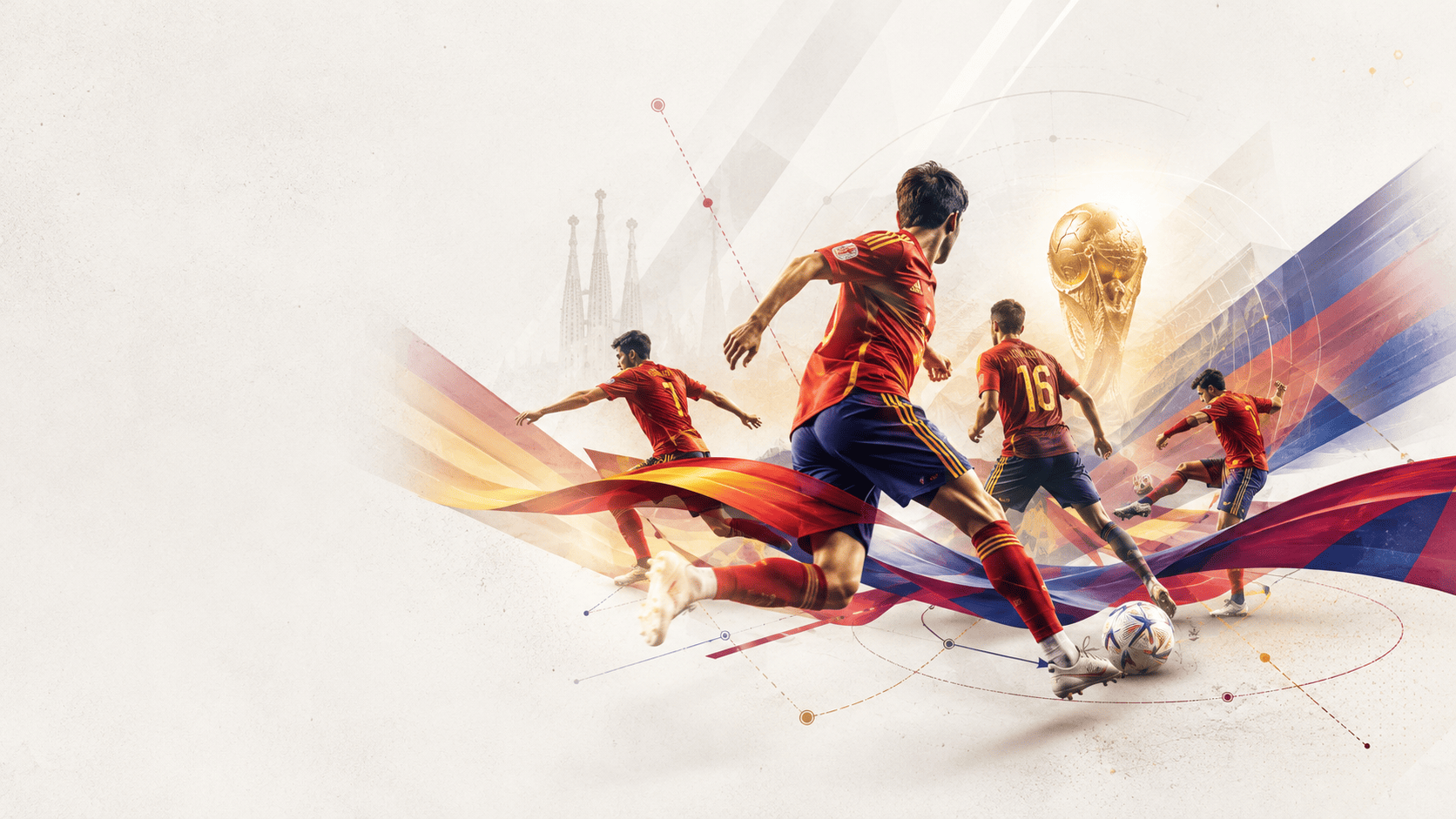
Spain ultimately lifted the trophy after defeating Argentina 1-0 following extra time in the final on July 19, 2026. Their success was not simply a victory for possession football. It was a triumph for a more complete model in which build-up, spacing, counter-pressing, defensive coverage and squad depth were connected.
FIFA’s Technical Study Group analysed every match and identified several recurring themes: back-three build-up structures, attacks through the inside channels, coordinated counter-pressing, increasingly sophisticated mid and low blocks, and goalkeepers becoming central participants in possession.
Formations Became Starting Points, Not Tactical Identities
A conventional formation graphic offered only a partial explanation of what teams were doing. A side listed in a 4-3-3 could build with three defenders, attack with five players across the opposition’s back line and defend in a compact 4-1-4-1.
Three-player build-up structures appeared in several forms. Some teams used three natural centre-backs. Others retained one full-back alongside two central defenders, while the opposite full-back advanced. Another variation involved a defensive midfielder dropping between or alongside the centre-backs.
The purpose was not merely to circulate possession safely. The extra player at the base created better passing angles and forced opposition forwards to make difficult decisions about when and where to press. It also released other players to occupy advanced positions.
Crucially, the same structure provided protection after possession was lost. The best teams did not separate attacking organisation from defensive transition. They built attacks with a clear idea of who would confront the first counter-attacking pass if the move broke down.
Width Was Used to Open the Inside Channels
World Cup 2026 did not signal the end of traditional wing play, but it changed its purpose. Elite teams often maintained maximum width to stretch the opposition before attacking the gap between the full-back and centre-back.
Wide players, central midfielders, forwards and even inverted full-backs made runs into this inside channel. Canada’s Richie Laryea was one example of a full-back moving inward, but such a run only worked because nearby team-mates coordinated their positions to clear the space.
Spain made inside-channel access a central feature of their attacking game. Their wingers held wide positions, forcing defenders to cover the full width of the pitch, while midfielders and forwards waited to penetrate the newly created gaps.
Before the final, Spain ranked third for central line breaks per 60 minutes of effective playing time. That figure helped explain why their long passing sequences were not empty possession. They patiently moved defensive blocks until the desired vertical lane became available.
Width, therefore, was frequently a means rather than an end. A winger could influence an attack without touching the ball simply by holding the opposition full-back away from the central zone.
Counter-Pressing Became an Attacking Weapon
FIFA’s analysts identified counter-pressing as one of the defining features of the group stage. The United States and Canada were among the leading teams in this phase, with Ecuador and Cabo Verde also producing strong examples.
Counter-pressing differs from an established high press. It occurs immediately after the ball is lost, when the opposition has not yet organised its attacking shape. A coordinated reaction can regain possession in a dangerous area or force an inaccurate clearance.
The key is collective spacing. One player sprinting toward the ball is not an effective counter-press. The surrounding team-mates must close nearby passing lanes and move over short distances as a connected unit.
This explains the widespread use of a 3+2 rest-defence structure, with three players behind the attack and two positioned in front of them. It provides enough numbers to surround a turnover while retaining protection if the first pressure is beaten.
Spain embodied the connection between possession and counter-pressing. Their first reaction after losing the ball was usually to attack the ball carrier and protect the central channel. Their defensive record was therefore not produced by sitting deep, but by preventing opponents from developing transitions in the first place.
Rest Defence Became the Hidden Foundation of Sustained Attacks
Rest defence describes the positioning of players behind an attack. Its purpose is to control the spaces an opponent would use during a transition.
A good rest-defence structure does not necessarily make a team more conservative. In many cases, it allows more players to attack because the team trusts the coverage behind them. The first forward pass after a turnover can be pressed, intercepted or channelled into a planned defensive duel.
France produced one of the tournament’s most distinctive examples against Morocco in the quarter-finals. Their defenders and midfielders formed an umbrella-like structure around Morocco’s potential outlets.
Dayot Upamecano and William Saliba were particularly important. One centre-back could step high to contest a loose ball or prevent Morocco from escaping, while the other protected the deeper central space. Their speed and one-on-one defending also allowed France to close attacks in wide areas.
This model highlighted the changing profile of elite centre-backs. Defending the penalty area remains essential, but modern teams also need defenders capable of stepping into midfield, covering large spaces and winning isolated duels far from goal.
Goalkeepers Became Free Players in the Build-Up
One of the tournament’s clearest statistical changes involved goal kicks. During the group stage, goalkeepers took only 52 per cent of them, down from 91 per cent at the 2022 World Cup.
Teams increasingly allowed a centre-back to restart play while the goalkeeper moved into a receiving position. This gave the goalkeeper time to observe the opposition’s pressing shape before deciding whether to play short, pass through a line or go directly over the pressure.
The development does not mean that every goalkeeper must constantly play short. Accurate long distribution was equally important. Zion Suzuki, Thibaut Courtois and Jordan Pickford demonstrated how one pass could bypass several opponents and turn pressure into territorial progress.
Cabo Verde goalkeeper Vozinha illustrated how this role also benefits teams that do not dominate possession. He attempted 106 line breaks across four matches, more than any other player in his team.
The modern goalkeeper is therefore not simply judged by saves or pass completion. Scanning, decision-making and the ability to recognise the opponent’s pressing trigger have become fundamental parts of the position.
Low Blocks Became More Intelligent and Adaptable
Mid and low blocks were highly visible throughout the tournament, especially when lower-ranked teams faced possession-heavy opponents. Yet the best defensive performances were not based on placing ten players near the penalty area without a plan.
Morocco used a cohesive mid-block that encouraged opponents to play wide. Japan defended with short distances between units and waited for the right moment to challenge for possession. Australia frequently defended with large numbers inside the box but maintained concentration and organisation over long periods.
Cabo Verde provided the most revealing case study. In their opening draw with Spain, they spent 27.3 minutes in a low block, compared with a tournament average of 7.4 minutes at that stage.
Their 4-5-1 structure remained compact but constantly adjusted to Spain’s movement. The striker stayed connected to Spain’s deepest midfielder, while the nearest defender applied pressure without allowing large gaps to develop.
Cabo Verde then became progressively more proactive. They defended higher against Uruguay and Saudi Arabia, counter-pressed more frequently and committed more players forward against Argentina. The lesson was significant: an underdog can begin cautiously without being trapped in a permanently passive identity.
The First Forward Pass Defined Attacking Transitions
Speed remains valuable in counter-attacking football, but World Cup 2026 emphasised that the first decision after regaining possession is often more important than raw pace.
If the first pass goes backwards or is delayed, the opposition receives time to recover its defensive structure. An early forward pass, by contrast, can release fast attackers before the space disappears.
FIFA’s review distinguished between transitions launched from an organised defensive block and those created through pressing or counter-pressing. After two rounds, 59 per cent of Uruguay’s attacking transitions had originated from pressing or counter-pressing, compared with a tournament average of 41.5 per cent.
Argentina offered a more controlled variation. Lionel Scaloni’s team could circulate the ball with short passes, attract pressure to one area and then accelerate abruptly. Midfielders moved toward wide zones to create overloads or drag opponents away from the centre.
Once the opposition had shifted toward one side, Argentina switched the point of attack and sent multiple runners forward at different angles. Their transition speed was therefore the product of earlier positional manipulation, not simply a collection of players sprinting toward goal.
Tactical Freedom Required Collective Compensation
The tournament showed that free roles still have a place in elite football, but freedom must be supported by a disciplined collective structure.
Argentina organised much of their game around Lionel Messi. Nine outfield players performed the bulk of the defensive work, while Messi was often kept in a position from which he could become the first attacking outlet after possession was regained.
His team-mates also understood that several defenders could be drawn toward him. They moved into the spaces created by that attention and provided passing options when he received under pressure.
The strategy was not simply to wait for individual inspiration. Argentina actively created the conditions in which Messi could influence the match. Midfield movements, wide overloads, switches of play and supporting runs were all designed around his qualities.
Norway used a related principle with Martin Ødegaard. Their captain drifted into the half-spaces, dropped to support the build-up and controlled when attacks accelerated. Leaving him unmarked allowed him to turn, but following him could open space for Erling Haaland to attack behind the defensive line.
Modern tactical freedom is therefore structured freedom. One player searches for the most valuable space, while the rest of the team adjusts to protect and exploit that movement.
Crosses and Set Pieces Returned in More Sophisticated Forms
Positional play and central combinations did not remove the value of crosses or dead-ball situations. Around one in every four goals at the tournament came from a set piece, with corners supplying approximately half of those goals.
Argentina and England scored seven set-piece goals each. Spain, by comparison, scored only three of their 14 goals from dead-ball situations, demonstrating that there was no single route to success.
Portugal showed how wide deliveries could be integrated into a deliberate attacking structure. Against Croatia, they slowed possession, created overloads, switched play and then attacked the penalty area at speed. Four attempts came from nine corners, and all six corners delivered directly into the box were inswingers.
Portugal also attempted 15 open-play crosses, with 14 arriving from the wide channels. One created the winning goal.
England took the approach even further against DR Congo, attempting 35 open-play crosses—their highest total in a World Cup match since 1966. It was a practical response to a compact defence that restricted central access.
The conclusion is not that crossing became inherently superior. Its value depended on the preparation before the delivery, the movement inside the box and the positioning for second balls. A structured cross is a tactical solution; repeated hopeful deliveries usually signal that a team has run out of better ideas.
The Bench Became Part of the Starting Plan
With finalists required to play eight matches, squad depth was not merely protection against injuries or fatigue. It became a central tactical resource.
Spain maintained their core principles after substitutions while introducing different physical and technical profiles. Mikel Merino scored shortly after coming on against Belgium and also delivered the 90+1-minute winner against Portugal.
An effective substitute can change more than the team’s energy level. A coach may introduce a stronger aerial target, an additional player between the lines, a second forward or a winger whose positioning allows the full-back to attack more aggressively.
Spain’s advantage was that these changes did not destroy their structure. The team continued to maintain width, protect the central channel and counter-press after losing possession. The personnel changed, but the relationships between positions remained coherent.
That ability to create a second version of the same game plan became especially valuable in knockout matches decided by small details.
Why Spain Produced the Tournament’s Most Complete Model
Spain did not win the World Cup simply because they completed more passes. Their real strength was the connection between each phase of the game.
They used width to move defensive blocks, attacked inside channels, counter-pressed immediately after losing possession and retained enough coverage to control counter-attacks. Their substitutes could alter the final-third threat without abandoning the team’s identity.
Before the final, Spain had conceded only one goal in seven matches and allowed just 11 shots on target, the best defensive record in the competition at that point. Yet this defensive success was produced through proactive positioning rather than permanent retreat.
Argentina offered a contrasting but equally relevant model. Scaloni’s side adjusted to different opponents, created collective conditions for Messi to thrive and moved between possession, low-block defending and rapid transitions.
The presence of both teams in the final demonstrated that international football does not reward one universal style. It rewards teams that understand their most valuable qualities and construct a coherent system around them.
The Lasting Tactical Impact of World Cup 2026
The tournament is likely to strengthen demand for goalkeepers who can manipulate a press, centre-backs capable of defending large spaces, full-backs comfortable both outside and inside, and midfielders who can rotate positions without damaging the team’s balance.
Pressing will also be evaluated differently. Coaches will focus less on how many players run toward the ball and more on the distances between them, the protection behind them and the direction in which the opposition is being forced.
For viewers, many of the most important actions now take place away from the ball: a centre-back stepping into midfield, a full-back entering the inside channel or an entire defensive line advancing before a counter-press. A stable, high-resolution viewing experience makes those structural details easier to follow across supported devices, which is where Rowad4K can add value for supporters who want to study the match rather than simply track the ball.
Conclusion
World Cup 2026 did not reveal a revolutionary new formation. Its most important tactical development was the integration of previously separate phases.
Teams built attacks with defensive transitions already in mind. They maintained width to open central spaces, used goalkeepers to create overloads and organised low blocks that could become platforms for aggressive counter-attacks.
Spain won because their model connected these elements more consistently than anyone else’s. The defining lesson of the tournament was therefore not that possession defeated transition football, or that attack defeated defence.
Modern superiority comes from moving between possession, pressing, recovery and defensive organisation without losing structure. The teams that mastered those connections shaped the tournament—and will influence the next stage of football’s tactical evolution.
Share this article